
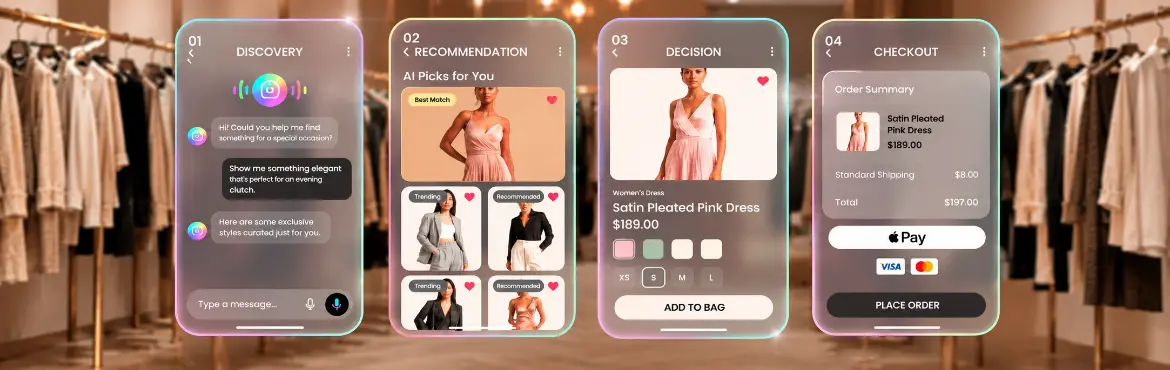
AI Shopping Assistants and the Future of eCommerce Product Discovery

-
Author Diginyze
-
Published November 05, 2026
-
2 comments Join the Conversation


The rules of product discovery are quietly changing.
Customers still buy products from retailers, but they are increasingly relying on AI systems to help decide which products deserve their attention in the first place.
For eCommerce businesses heading into 2027, that creates a new challenge. Products need to do more than appear in search results. They need enough context, structure, and supporting information to be surfaced, compared, and recommended by AI shopping assistants.
Why AI Shopping Assistants Matter in eCommerce
An AI shopping assistant in eCommerce can shape a shortlist before a shopper reaches your store. If your catalog offers little beyond names and broad descriptions, products may be hard to compare. Visibility alone is no longer enough. Attributes, pricing, availability, and policies make products recommendable.
How an AI Shopping Assistant Improves Product Discovery
Understanding Customer Intent
Filters assume shoppers know which attributes matter. A shopper may want a quiet dishwasher or a laptop for frequent travel. An assistant can interpret the need and ask follow-ups, helping retailers surface products standard filters might miss.
Delivering More Relevant Recommendations
The assistant can compare specifications, reviews, compatibility, price, and stock, then explain why an option fits. Your team needs product information consistent across catalogs and channels to make comparisons accurate. Product data now influences whether an item is considered, compared, and recommended.
Reducing Friction During Purchase Decisions
An AI shopping assistant in eCommerce may confirm stock, clarify delivery or return terms, and help build a basket. This resolves uncertainty while purchase intent is high without taking control from the customer.
How AI Recommendations Are Changing eCommerce
That's where AI recommendations become commercially important. They can interpret current intent alongside product attributes, reviews, and availability, not just browsing history.
Looking ahead to 2027, recommendation quality will matter as much as volume. A useful AI recommendation explains fit, highlights trade-offs, and offers an alternative when stock changes. Retailers evaluating AI recommendation products should check catalog coverage, attribute accuracy, explainability, and assisted conversions.
Relevant AI-recommended products can bring less-visited inventory into consideration. Poorly matched AI-recommended products add noise and weaken trust.
Well-matched AI-recommended products should improve the shortlist, not just generate clicks. Measure purchases, returns, and discovery quality, not clicks alone.
AI Agents and the Next Step in eCommerce
Shopping assistants are becoming part of broader agentic commerce experiences. An AI agent may compare products, check inventory, track orders, or support buying tasks. Some systems are adding Agentic AI for approved actions, but customers should remain in control of payments and order changes. Done well, this reduces shopper effort and the routine service workload.
As agentic commerce experiences expand from product comparison to inventory checks and purchase support, eCommerce teams need clear guidelines on what AI agents can access, which tasks they can perform, and when human intervention is necessary
The Growing Role of AI in Retail
These expectations aren't limited to eCommerce websites. AI in retail can help associates locate stock and suggest alternatives, while apps and kiosks connect online research with in-store service.
By 2027, customers will expect continuity across channels. Product details, promotions, and availability should match across your website, app, stores, and customer service. A shopping experience that continues across digital touchpoints lets customers pick up where they left off. AI in retail works best with shared, reliable information.
What Businesses Should Consider Before Implementing an AI Shopping Assistant
Delivery depends on sound foundations.
-
Data quality: Descriptions need useful attributes, variants, prices, and current stock. An assistant can only make reliable comparisons with reliable information. A clean and consistent view of product data helps reduce mismatches.
-
Customer trust and privacy: Identify AI interactions, explain data use, and collect only what's necessary. Keep human support available and limit access to sensitive information. A joined-up view of customer information can support service when access is controlled.
-
System integration: Assistants may need product, pricing, inventory, CRM system, order management, and fulfillment data. Conflicting systems produce conflicting answers. Build reliable ecommerce connectors between commerce platforms and operational systems, and test for missing records, unavailable stock, and failed data handoffs..
Start with product comparison or availability checks. Track accuracy, assisted conversions, satisfaction, and escalations before expanding.
Preparing Your eCommerce Strategy for 2027
Once the foundations are in place, decide how much of the journey an assistant should support. An AI shopping assistant in eCommerce should complement owned channels, not weaken the customer relationship.
Review what external assistants can access and which actions need approval. Some shoppers will want research support but keep checkout control; others may delegate more. Build for both, and measure conversion alongside returns.
Conclusion
AI shopping assistants are changing where discovery begins. As 2027 approaches, being searchable will not be enough; products must also be understandable and recommendable across channels. Retailers with reliable product data, connected operations, and clear customer protections will be better placed to earn consideration.
FAQs
1. What is an AI shopping assistant in eCommerce?
It helps shoppers compare products and move toward a purchase. Depending on permissions, it may check availability, explain policies, or help with approved actions such as building a basket.
2. How do AI recommendations improve product discovery?
They connect shopper needs with product attributes, reviews, price, and availability. Explaining why an item fits and suggesting alternatives makes comparisons more useful.
3. How is AI used in retail?
AI in retail supports discovery, associate tools, stock checks, and service across websites, apps, kiosks, and stores. Shared product and stock information keeps experiences consistent.
4. Can an AI shopping assistant increase conversions?
It can answer questions about product fit, stock, delivery, and returns while intent is high. Results depend on accuracy and human support when needed.
5. What data does an AI shopping assistant need?
It needs accurate product descriptions, attributes, prices, promotions, stock, delivery details, and return policies. Personalization may use preferences or purchase history with permission.





Recent Blogs
The latest insight into technology and Ecommerce
AI Shopping Assistants and the Future of eCommerce Product Discovery
AI shopping assistants are changing where discovery begins. As 2027 approaches, being searchable will not be enough products must also be...
KNOW MORE
Unified Commerce vs Omnichannel: What’s the Difference?
The omnichannel vs unified commerce debate is not about choosing a winner. It is about identifying the approach that best supports your customer...
KNOW MORE
How ERP Integration Simplifies Multi-Store eCommerce
eCommerce connectors make this synchronization possible, linking platforms without forcing teams to manage information store by store. The result...
KNOW MORE – 1 2.webp)
Multi-Store eCommerce Migration: The Complete Enterprise Guide
If you're running more than one storefront right now, you already know the feeling. One team is fighting inventory mismatches on Store A. Another is...
KNOW MORE
What Is Augmented Reality in eCommerce? How AR Works & Why Online Stores Need It
Augmented reality removes the guesswork from online shopping, helping customers buy with confidence. The result? Higher conversions, fewer returns,...
KNOW MORE

Advanced AI Security for your Online Store by Diginyze
Cyber Security for eCommerce
Diginyze: Discover the Future of eCommerce Analytics
Diginyze eCommerce Analytics
AI-Driven eCommerce Marketing with Diginyze
eCommerce
Diginyze's AI Search for eCommerce Store
AI in eCommerce
Diginyze's AI-Powered Intelligent eCommerce Platform
AI-Powered eCommerceDiginyze's AI-Native eCommerce for B2B, B2C & Marketplaces
AI-Native eCommerceCase Studies




Your Digital Transformation Starts Here!
Join thousands of businesses transforming with Diginyze. Sign up today and start now!