
Multi-Store eCommerce Migration: The Complete Enterprise Guide

-
Author Diginyze
-
Published September 18, 2026
-
2 comments Join the Conversation


If you're running more than one storefront right now, you already know the feeling. One team is fighting inventory mismatches on Store A. Another is patching a broken checkout on Store B.
Somewhere in a spreadsheet, someone is manually reconciling orders across three platforms because nothing talks to anything else. Multi-store growth was supposed to unlock new markets. Instead, it's turned into a full-time job just keeping the lights on.
This is the quiet reality for a lot of enterprises and fast-scaling eCommerce brands. You didn't plan to end up with five disconnected systems. It happened one acquisition, one regional launch, one "let's just spin up a quick store for this" decision at a time. And now, replatforming feels less like an upgrade and more like defusing a bomb.
Here's the good news: A lot of brands are solving it right now by moving to a unified, AI-native eCommerce platform. Let's talk about it.
Why Multi-Store Brands Hit a Wall
Running two, five, or fifty storefronts sounds like a scale story. In practice, it's often a fragmentation story. A few patterns show up again and again:
Inventory lives in silos. Each store tracks its own stock, so a product can show "in stock" on one site and "sold out" on another, even when it's the same warehouse. Overselling, canceled orders, and frustrated customers follow close behind.
Orders scatter across systems. Without a single view, fulfillment teams are toggling between dashboards, exporting CSVs, and manually stitching together what should be one operational picture. Every extra click is a chance for something to fall through the cracks.
Customer data doesn't follow the customer. A shopper who buys from your US store and your EU store looks like two different people to your systems. That kills personalization, loyalty programs, and any real understanding of lifetime value.
Content and localization become a second job. Translating product pages, promotions, and policies across storefronts by hand doesn't scale, and inconsistent messaging quietly erodes brand trust in every new market you enter.
Tech debt piles up fast. Different platforms, plugins, and payment gateways per store means every update, security patch, or new feature has to be built (or bought) multiple times.
None of these are a people problem. It's an architecture problem. And it tends to get worse, not better, the more successful a brand becomes because growth means more stores, more regions, and more complexity layered on top of a foundation that was never built for it.
The Real Fix: A Unified eCommerce Platform, Not More Patchwork
The instinct when things get messy is often to add another tool: a middleware layer here, an integration there. It buys time, but it doesn't fix the underlying issue: your stores are still having separate systems pretending to be one business.
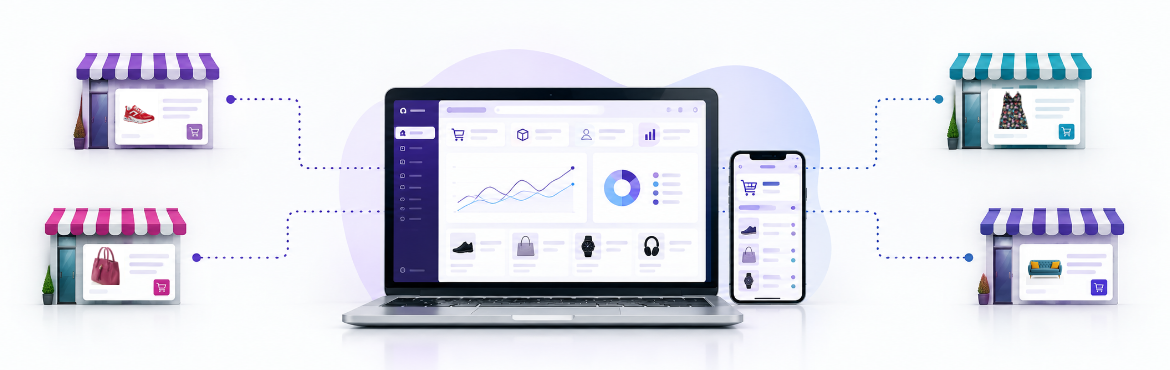
A unified multi-store eCommerce platform flips that model. Instead of stitching together disconnected storefronts after the fact, everything, including inventory, orders, customers, content, and pricing, lives on one platform from the start, with each store operating as a configured instance rather than a standalone silo.
For retail chains, franchises, and multi-brand groups, this matters in very practical ways:
-
One inventory source of truth, so stock levels are accurate everywhere, all the time.
-
One order management layer, so fulfillment teams see every order, from every store, in one place.
-
One customer record, so a shopper's history follows them across brands and regions instead of resetting at each storefront.
-
One content and localization workflow, so launching in a new language or market doesn't mean rebuilding your content operation from scratch.
This is the shift most multi-store brands eventually make, not because unification is trendy, but because it's the only model that scales without multiplying your operational overhead alongside your store count.
How Diginyze Approaches Multi-Store eCommerce
Diginyze is an AI-native eCommerce platform built exactly to address this concern. According to Deloitte's 2026 survey, 75% of retail executives identify AI as a top strategic priority, yet only 16.5% can actually quantify its value. This exact gap is driving the demand for smart enterprise eCommerce systems like Diginyze that move past the hype to deliver measurable business outcomes.
Centralized Order Management for Multiple Stores:
Every order, from every storefront, flows into a single dashboard. Fulfillment, customer service, and finance teams stop switching between systems and start working from one operational view, which means faster fulfillment and far fewer order errors.
AI-Driven Inventory Across Storefronts:
Stock levels and inventory sync in real time across every store on the platform, so a sale in one channel is instantly reflected everywhere else. That's the difference between confidently promising delivery dates and constantly issuing apology emails for out-of-stock cancellations.
Did you know?
95% of retail and CPG respondents reported that AI reduced annual costs, while 89% said it increased annual revenue, according to NVIDIA's 2026 State of AI in Retail and CPG survey.
Multi-Store eCommerce Setups Built for Retail Chains:
Whether you're organizing stores by location, franchise, product category, or B2B/B2C, Diginyze lets you configure distinct branding, catalogs, and pricing per store while keeping the underlying data and operations unified.
Built-In Translation and Localization Management:
Instead of manually managing separate content workflows for each storefront, Diginyze's eCommerce CMS and internationalization support lets you manage multi-language, multi-currency, and region-specific content from one dashboard, sharing content where it makes sense and customizing it where it doesn't, without duplicating your content team's workload for every new market.
Guided, Low-Disruption Migration:
Replatforming is usually the scariest part of this decision, and rightly so. A mishandled eCommerce platform migration can mean lost SEO rankings, broken order history, or downtime during peak sales. Diginyze's eCommerce platform migration process is structured around data mapping, phased cutovers, and pre-launch testing, so historical orders, customer accounts, and product catalogs move over intact rather than getting rebuilt from scratch.
What an eCommerce Platform Migration Actually Looks Like
An eCommerce platform migration doesn't have to mean ripping everything out and starting over. A well-run eCommerce replatforming process generally follows a few clear phases:
-
Audit and Data Mapping: Cataloging every store's products, orders, customer records, and integrations before anything moves.
-
Architecture Planning: Deciding how stores will be structured on the new platform (by brand, region, channel, or customer segment).
-
Phased Migration: Moving stores in stages rather than all at once, so issues are caught early and revenue isn't put at risk.
-
Testing and Validation: Checking checkout flows, payment gateways, tax rules, and inventory sync before go-live.
-
Cutover and Monitoring: Switching traffic over with a rollback plan in place and watching performance closely in the first weeks.
The goal isn't just "get everything onto the new system." It's getting there without losing search rankings, without breaking customer accounts, and without a single day of downtime during a sale.
Bringing It All Together
Multi-store growth shouldn't feel like managing five separate businesses that happen to share a logo. The brands pulling ahead right now are the ones treating their storefronts as one connected operation, shared inventory, shared customer intelligence, and shared content workflows, instead of five parallel fire drills.
If your team is spending more time reconciling systems than actually growing the business, that's usually the clearest sign it's time to unify. And if replatforming feels risky, the right migration partner should be making it feel a lot less like a leap and a lot more like a plan.
Curious what this would look like for your stores?
Request a demo of Diginyze's multi-store eCommerce platform and see how a unified system could simplify the way you run every storefront.
FAQs
1. How long does an eCommerce platform migration typically take?
It depends on the number of stores, catalog size, and integrations involved, but most multi-store migrations are planned in phases over several weeks to a few months. A phased approach moving one store or region at a time is generally safer than a single all-at-once cutover, especially for brands that can't afford downtime during peak selling periods.
2. Will I lose my SEO rankings when I migrate to a new platform?
Not if the migration is handled properly. Rankings are typically at risk when URLs change without proper redirects, or when metadata and site structure aren't carried over correctly. A structured migration process includes URL mapping and redirect planning specifically to protect existing search visibility.
3. Can Diginyze manage translations and localization across all my storefronts from one place?
Yes. Diginyze supports multi-language and multi-currency management from a single dashboard, so you can share content across storefronts where it makes sense or customize it per region or brand without running separate content workflows for every store you operate.
Related Blogs

Industrial Buying Made Easier: Embrace AI-Powered eCommerce

The Power of Push Notifications: Engaging Shoppers on Mobile

eCommerce Branding: Your Ultimate Guide

How Headless Commerce is Rewriting the Rules of eCommerce?

Recent Blogs
The latest insight into technology and Ecommerce
AI Chatbot for eCommerce: The 24/7 Strategy to Drive 70%+ Conversions and Scale
Did you know? 71% of Gen Z customers buy items via chatbots and 40% of customers use retail digital assistants.
KNOW MORE
AI for Small Retailers: How to Thrive in the E-Retail Revolution
Did you know that U.S. eCommerce sales are expected to hit a record $1.192 trillion in this year, up from $571 billion in 2019?
KNOW MORE
AI-Powered vs. Traditional eCommerce Website Builder: Don’t Get Left Behind!
Choosing the right eCommerce Website Builder is crucial for any eCommerce business.
KNOW MORE
Why Top U.S. Enterprises Are Ditching Legacy eCommerce for AI-First Platforms Like Diginyze
Did you know that U.S. eCommerce sales crossed $1.1 trillion in 2024, yet over 64% of enterprise brands say .....
KNOW MORE
How AI Personalization is Driving a 25% Sales Surge
Did you know? AI-powered search functionalities can increase eCommerce conversion rates by up to 43%, significantly enhancing the efficiency of online shopping platforms. In today's fast-paced eCommerce world, time is of the essence. Customers are no longer willing to sift through endless pages of products just to find what they’re looking for.
KNOW MORE
AI Overviews are Killing Your Traffic: What to do in 2026 and Beyond
Google’s AI Overviews are reshaping search visibility in 2026, causing traffic drops across eCommerce.
KNOW MORE

Advanced AI Security for your Online Store by Diginyze
Cyber Security for eCommerce
Diginyze: Discover the Future of eCommerce Analytics
Diginyze eCommerce Analytics
AI-Driven eCommerce Marketing with Diginyze
eCommerce
Diginyze's AI Search for eCommerce Store
AI in eCommerce
Case Studies




Your Digital Transformation Starts Here!
Join thousands of businesses transforming with Diginyze. Sign up today and start now!