
How ERP Integration Simplifies Multi-Store eCommerce

-
Author Diginyze
-
Published October 16, 2026
-
2 comments Join the Conversation


Opening a new eCommerce store is easy. Keeping inventory, orders, and operations connected across multiple stores is where it counts to integrate ERP.
More stores mean more opportunities, but they also mean more systems, more data, and more operational challenges. Inventory becomes fragmented, reporting loses accuracy, and teams spend valuable time reconciling information across platforms.
That is why growing businesses integrate ERP with a multi-store eCommerce platform. With the right eCommerce ERP solution, companies can centralize business data, automate everyday processes, and manage multiple stores through a unified operational system.
Instead of adding complexity with every new storefront, effective eCommerce integration helps businesses scale while maintaining visibility, accuracy, and control.
The Hidden Cost of Disconnected Commerce
Disconnected commerce rarely looks like a crisis, but the real threat is hiding underneath. At first, spreadsheets bridge gaps, teams update inventory manually, and reports pull data from multiple systems. Then the cracks widen.
A missed price update creates inconsistency. Inventory mismatches lead to overselling. Finance spends days reconciling numbers. Leaders make decisions without a clear view of performance.
According to a report, enterprises use 957 applications, yet only 27% are integrated. The result? More silos, manual work, and unreliable data.
For businesses operating a multi-store eCommerce platform, these issues affect more than productivity. They can disrupt fulfillment, delay customer service, and prevent leaders from making decisions using reliable information.
Connected commerce changes the equation. When storefronts, ERP, CRM, inventory, and finance systems communicate in real time, teams work faster, customers get consistent experiences, and businesses scale with control.
ERP Integration Is Not a Connection. It Is Control.
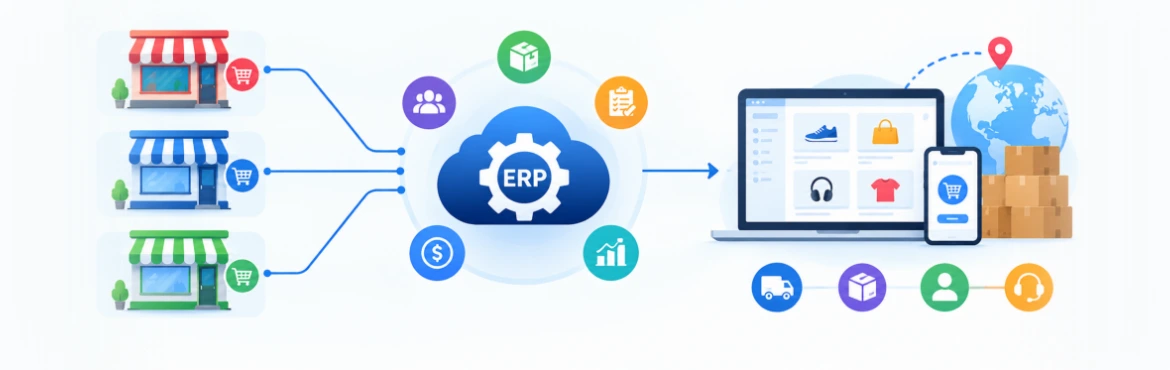
Integrating ERP with a multi-store eCommerce platform is not about making systems talk. It is about creating one reliable source of operational truth. Products. Inventory. Customers. Orders. Shipping. Finance.
For example, an inventory update needs to reach every relevant store without delay. An order placed on one storefront should flow into the ERP with the correct details, while shipping and financial records should stay aligned as the order moves through fulfillment.
eCommerce connectors make this synchronization possible, linking platforms without forcing teams to manage information store by store. The result goes beyond faster operations. Businesses gain a unified view of what is selling, what is available, and where action is needed.
Why Traditional Integration Approaches Fail
One of the biggest mistakes organizations make is treating every store as its own independent technology project. When a company operates two or three storefronts, point-to-point integrations may appear manageable. However, as the business grows, complexity grows.
Each new store creates additional maintenance requirements, data synchronization risks, and operational dependencies. Eventually, teams spend more time managing integrations than improving customer experiences.
A better approach is to build a centralized integration architecture. Here, eCommerce storefronts connect through a unified integration that communicates with the ERP platform. Rather than creating individual connections for every channel, information flows through a single framework that standardizes communication and data management.
The advantage is scalability. When businesses launch a new storefront, enter a new market, or expand, they can do so without redesigning their entire technology ecosystem. Growth becomes easier because the underlying infrastructure is designed to support it.
Data Mapping: The Step Most Businesses Underestimate
Connecting systems is easy. Making their data speak the same language is where the real work begins. One product can have different SKUs, names, prices, or categories across storefronts.
The result: Incorrect listings, unreliable inventory, and teams that stop trusting the system.
Inventory mapping raises the stakes. One mismatch can trigger overselling, stock imbalances, and fulfillment delays, especially across multiple warehouses and regional centers.
The same applies to customer, order, and financial data. Profiles, purchase histories, loyalty points, payment statuses, taxes, refunds, discounts, and settlements must remain aligned from storefront to ERP.
Because synchronized systems with inconsistent data are still disconnected where it matters. Successful integration does not begin with APIs or connectors. It begins with clear data standards, ownership, and validation rules.
Get the foundation right first. Technology can then deliver accurate insights, smoother operations, and decisions leaders can trust.
Step-by-Step Guide to Integrate ERP with a Multi-Store eCommerce Platform
Successful ERP integration starts with a strategy. Focus on these key steps:
Step 1: Assess Current Operations
-
Review order, inventory, and reporting workflows.
-
Identify data silos and manual processes.
Step 2: Define Integration Goals
-
Establish priorities such as inventory visibility, faster fulfillment, or centralized reporting.
-
Align integration objectives with business growth plans.
Step 3: Standardize and Map Data
-
Align product catalogs, SKUs, customer records, and pricing structures.
-
Define how information will flow between systems.
Step 4: Select the Right Integration Approach
-
Choose API-based integrations, middleware, or native ERP integrations based on scalability requirements.
-
Ensure the architecture can support future stores and channels.
Step 5: Test, Launch, and Optimize
-
Validate inventory, order, customer, and financial data synchronization.
-
Continuously monitor performance and refine workflows after deployment.
Common Challenges That Slow Multi-Store Growth
Every growing eCommerce business eventually encounters operational friction. The symptoms are often different, but the root cause is frequently the same: disconnected systems.
Data silos prevent teams from accessing consistent information. Legacy infrastructure limits scalability. Inventory inaccuracies create fulfillment challenges. Manual workflows consume valuable time. Reporting delays reduce decision-making agility.
Perhaps most importantly, expansion becomes increasingly difficult. New stores should create new opportunities. Without integration, they often create new complexities.
Why Integrated Commerce Creates a Competitive Advantage
The future of eCommerce belongs to businesses that can move quickly without sacrificing control. That requires more than strong marketing, attractive storefronts, or a larger product catalog. It requires connected operations.
When eCommerce data, operational processes, financial information, and customer insights work together, businesses gain the visibility needed to make confident decisions.
Forecasting becomes more accurate. Inventory planning improves. Customer experiences become more consistent. Operational costs become easier to manage. Most importantly, teams spend less time searching for information and more time acting on it.
That is the true value of an integrated commerce environment: not automation alone, but business agility.
Connect Every Store Through One ERP
More stores create more opportunities, but they also increase the volume of orders, inventory updates, and business data that must be managed.
Diginyze’s eCommerce ERP capabilities are part of its multi-store eCommerce platform, helping businesses connect their commerce operations and manage growth through a more unified workflow.
The key is to integrate ERP around clear business requirements, reliable data mapping, and a scalable architecture. When your systems work together, managing multiple stores becomes easier to coordinate and optimize.
Ready to get every storefront working as one business?
FAQs
1. Why is it important to integrate ERP with a multi-store eCommerce platform?
ERP integration creates a centralized operational environment where inventory, orders, customer information, and financial data remain synchronized across all stores. This improves accuracy, efficiency, and decision-making.
2. What are the biggest challenges in ERP eCommerce integration?
The most common challenges include inconsistent data structures, inventory synchronization issues, legacy systems, manual workflows, and limited visibility across multiple storefronts.
3. How long does it take to integrate ERP with multiple eCommerce stores?
Implementation timelines vary depending on business complexity, existing systems, data quality, and customization requirements. Most projects take several weeks to several months.
4. Can one ERP system support multiple eCommerce storefronts?
Yes. Modern eCommerce ERP solutions are designed to manage multiple brands, regions, storefronts, warehouses, and sales channels from a centralized platform while maintaining consistent data across the organization.
Related Blogs


Unwrapping Success: Tackling Online Retail Challenges This Holiday

AI-Powered eCommerce: More Sales, Less Effort


How Diginyze is Redefining D2C eCommerce?
Recent Blogs
The latest insight into technology and Ecommerce
AI Chatbot for eCommerce: The 24/7 Strategy to Drive 70%+ Conversions and Scale
Did you know? 71% of Gen Z customers buy items via chatbots and 40% of customers use retail digital assistants.
KNOW MORE
AI for Small Retailers: How to Thrive in the E-Retail Revolution
Did you know that U.S. eCommerce sales are expected to hit a record $1.192 trillion in this year, up from $571 billion in 2019?
KNOW MORE
AI-Powered vs. Traditional eCommerce Website Builder: Don’t Get Left Behind!
Choosing the right eCommerce Website Builder is crucial for any eCommerce business.
KNOW MORE
Why Top U.S. Enterprises Are Ditching Legacy eCommerce for AI-First Platforms Like Diginyze
Did you know that U.S. eCommerce sales crossed $1.1 trillion in 2024, yet over 64% of enterprise brands say .....
KNOW MORE
How AI Personalization is Driving a 25% Sales Surge
Did you know? AI-powered search functionalities can increase eCommerce conversion rates by up to 43%, significantly enhancing the efficiency of online shopping platforms. In today's fast-paced eCommerce world, time is of the essence. Customers are no longer willing to sift through endless pages of products just to find what they’re looking for.
KNOW MORE
AI Overviews are Killing Your Traffic: What to do in 2026 and Beyond
Google’s AI Overviews are reshaping search visibility in 2026, causing traffic drops across eCommerce.
KNOW MORE

Advanced AI Security for your Online Store by Diginyze
Cyber Security for eCommerce
Diginyze: Discover the Future of eCommerce Analytics
Diginyze eCommerce Analytics
AI-Driven eCommerce Marketing with Diginyze
eCommerce
Diginyze's AI Search for eCommerce Store
AI in eCommerce
Diginyze's AI-Powered Intelligent eCommerce Platform
AI-Powered eCommerceDiginyze's AI-Native eCommerce for B2B, B2C & Marketplaces
AI-Native eCommerceCase Studies




Your Digital Transformation Starts Here!
Join thousands of businesses transforming with Diginyze. Sign up today and start now!