

What Is Augmented Reality in eCommerce? How AR Works & Why Online Stores Need It

-
Author Diginyze
-
Published September 02, 2026
-
2 comments Join the Conversation


Online shopping has one problem that hasn't changed in 25 years: customers can't touch, try, or test what they're buying. They're guessing at size, color, and fit based on photos alone, a form of guesswork that's expensive for shoppers who get the wrong product and for businesses absorbing the cost of returns and lost trust.
Augmented reality (AR) is closing that gap. For enterprises evaluating where to invest their eCommerce budget next, AR is no longer a gimmick, it's a practical solution that improves conversions, reduces returns, and gives customers the confidence to buy sight unseen.
This blog breaks down what AR in eCommerce is, how it works, the business case for adopting it, and how to implement it on your own store.
What Is Augmented Reality in eCommerce?
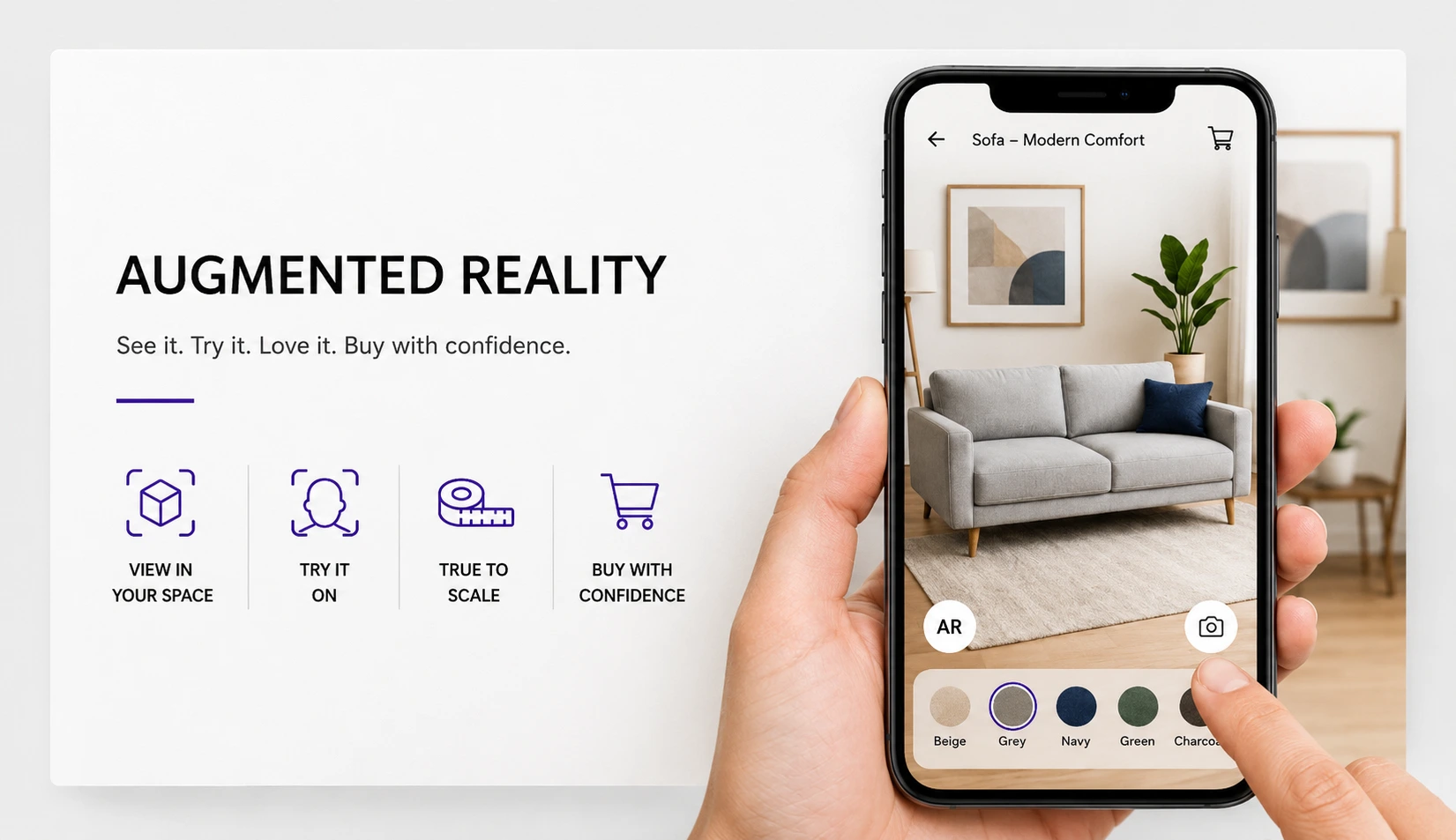
Augmented reality in eCommerce is the use of AR technology to overlay digital elements, 3D product models, animations, or interactive graphics onto a customer's real-world environment through a smartphone, tablet, or web browser. Instead of just viewing a product photo, shoppers see how that product looks and fits in their own space, or on their own body, in real time.
It's easy to confuse augmented reality (AR) with virtual reality (VR). VR replaces the real world with a fully simulated one, the shopper puts on a headset and steps into a virtual store. AR keeps the real world in view and adds digital layers on top of it. That makes it far more practical for eCommerce: it works on devices customers already own, and no headset is required.
Common examples: a furniture brand letting customers place a virtual sofa in their living room, a beauty brand offering a lipstick "try-on" through the phone camera, or an eyewear retailer showing how frames look on a customer's face.
How Does AR Work for Online Shopping?
At a technical level, AR for eCommerce relies on a few core components working together:
-
Camera and Sensor Input: The customer's device camera captures their real environment (a room, their face, their hand) in real time.
-
3D Product Models: Instead of static images, products are digitized into 3D models with accurate dimensions, textures, and materials.
-
Computer Vision and Tracking: The AR software analyzes the camera feed to understand surfaces, distances, and spatial coordinates, so the digital object can be placed accurately: a table stays on the floor, a ring stays on a finger, and a picture frame stays on a wall.
-
Rendering Engine: This layer overlays the 3D model onto the live camera feed, adjusting lighting, shadow, and scale so it looks natural rather than pasted on.
-
Delivery Layer: This is what the customer actually interacts with a native app feature, a WebAR experience that runs directly in a mobile browser (no app download needed), or an augmented reality viewer embedded in a product page that scans and displays AR content on demand.
Most modern eCommerce AR experiences run through WebAR, which means a customer can tap "View in your space" or "Try it on" directly from a product page and the AR experience loads instantly in their browser. This is a major shift from a few years ago, when AR required a dedicated app, a barrier that limited adoption. Removing that friction is a big part of why AR is now accessible to businesses of every size, not just large retailers with app-development budgets.
Benefits of Augmented Reality for eCommerce Businesses
AR delivers measurable outcomes across the customer journey, not just a nicer-looking product page.
1. Builds buying confidence. Customers see how a product will look, fit, or perform before they buy, no more guesswork.
2. Reduce returns and exchanges. By giving shoppers, a realistic preview of size, color, fit, and placement before purchase, AR helps set accurate expectations and reduces the likelihood of products being returned or exchanged.
3. Differentiates your brand. Most competitors still use static images, so an AR experience signals that you're modern and customer-focused.
4. Increases engagement. Interactive features keep shoppers on-site longer, which correlates with higher purchase intent.
5. Improves satisfaction. When expectations match reality, negative reviews drop.
6. Generates richer customer data. What customers view, place, or try on feeds directly into merchandising and marketing decisions.
7. Works across industries. Furniture, fashion, beauty, eyewear, jewelry, automotive, and even industrial equipment brands, all use AR to help buyers visualize products. It's far from a niche tactic.
How AR Increases Conversion Rates in eCommerce
Conversion rate is the metric every decision-maker cares about, and AR has a direct impact on it.
Did you know?
AR-powered product experiences have been shown to significantly lift eCommerce conversion rates by as much as 94%.
The reason is simple: uncertainty kills conversions. When a shopper isn't sure a couch will fit their living room or a foundation shade matches their skin tone, they hesitate, and hesitation often ends in an abandoned cart. AR removes that uncertainty right on the product page, right before the "Add to Cart" decision.
Products with AR visualization tend to see stronger add-to-cart rates and faster decisions than those shown with static images alone. Shoppers who interact with AR shopping experience are also more likely to convert, since interaction signals real purchase intent, placing a virtual chair in their living room means they're already picturing ownership.
It also cuts down pre-purchase questions. Instead of messaging support to ask "Will this fit?" or "What does this color look like?", customers answer those questions themselves, shortening the path to checkout.
Does AR Reduce Product Returns for Online Stores?
Yes, and this is one of the strongest financial arguments for adopting AR. Returns are one of the most expensive line items in eCommerce operations, covering reverse shipping, restocking, repackaging, and in many cases, discarded inventory that can no longer be resold as new.
A large share of returns happens for entirely preventable reasons: the product didn't look the way the customer expected, it didn't fit the space, or the size or color was wrong. AR directly addresses each of these causes by giving shoppers an accurate, true-to-scale, true-to-color preview before they buy.
Retailers that have implemented AR product visualization, particularly in furniture, apparel, and home goods, report measurably lower return rates on AR-viewed products compared to products purchased without any AR interaction. Fewer returns don’t just save on logistics costs, they also protect profit margins that are otherwise quietly eroded by processing and restocking expenses.
For eCommerce brands evaluating ROI, this is often the clearest, most quantifiable benefit: AR isn't only a tool to drive new sales, it's a tool to protect the sales you've already made.
How to Implement AR on My eCommerce Website?
Implementing AR doesn't require rebuilding your site or launching an app from scratch. Here's a practical path:
1. Identify the right products first. Start with SKUs where visual uncertainty and return rates are highest: furniture, apparel, footwear, beauty, eyewear, jewelry, and home decor typically see the fastest ROI.
2. Choose WebAR over app-only solutions. It runs directly in the browser, with no download needed, and works across iOS and Android.
3. Create accurate 3D models. This is the foundation, poorly scaled or low-quality models hurt trust rather than build it.
4. Integrate with your existing platform. AR can usually be added as an extension or integration without disrupting checkout or catalog systems.
5. Place AR entry points where decisions happen. The "View in your space" or "Try it on" button belongs next to Add to Cart, not buried elsewhere.
6. Test and measure. Check across devices and lighting conditions, then track add-to-cart, conversion, and return rates for AR-viewed products versus non-AR products.
7. Work with an experienced partner. Accurate 3D models and clean WebAR integration take specialized expertise. An eCommerce platform like Diginyze helps you launch faster and avoid costly missteps.
Conclusion
Augmented reality removes the guesswork from online shopping, helping customers buy with confidence. The result? Higher conversions, fewer returns, and a better customer experience. As AR becomes more accessible, it's quickly becoming a competitive advantage for eCommerce brands.
Ready to elevate your online store?
Explore Diginyze, an AI-native eCommerce platform to start creating immersive shopping experiences today.
FAQs
1. What is augmented reality, in simple terms?
Augmented reality (AR) overlays digital content onto the real world through a smartphone, tablet, or camera-enabled device. It lets users see virtual products in their actual environment before making a purchase.
2. What is the difference between AR and VR for eCommerce?
AR adds digital elements to the real world using a smartphone or browser, while VR creates a fully virtual environment. AR is more practical for eCommerce because it requires no special headset.
3. Do I need a mobile app to offer AR on my eCommerce store?
No, most modern AR experiences run through WebAR, which works directly in a mobile browser. Customers can access AR features without downloading an app.
4. Which eCommerce industries benefit most from AR?
Furniture, home décor, fashion, beauty, footwear, eyewear, and jewelry brands often see the biggest impact from AR. Any business selling products that require fit, size, or visual evaluation can benefit.
Related Blogs

What Does 5G Mean for Your Online Store?


5 Ways to Secure Your E-Commerce Against Cyber Threats


Your Ultimate Guide to eCommerce Success: Top 9 Growth Marketing Strategies
Recent Blogs
The latest insight into technology and Ecommerce
AI Chatbot for eCommerce: The 24/7 Strategy to Drive 70%+ Conversions and Scale
Did you know? 71% of Gen Z customers buy items via chatbots and 40% of customers use retail digital assistants.
KNOW MORE
AI for Small Retailers: How to Thrive in the E-Retail Revolution
Did you know that U.S. eCommerce sales are expected to hit a record $1.192 trillion in this year, up from $571 billion in 2019?
KNOW MORE
AI-Powered vs. Traditional eCommerce Website Builder: Don’t Get Left Behind!
Choosing the right eCommerce Website Builder is crucial for any eCommerce business.
KNOW MORE
Why Top U.S. Enterprises Are Ditching Legacy eCommerce for AI-First Platforms Like Diginyze
Did you know that U.S. eCommerce sales crossed $1.1 trillion in 2024, yet over 64% of enterprise brands say .....
KNOW MORE
How AI Personalization is Driving a 25% Sales Surge
Did you know? AI-powered search functionalities can increase eCommerce conversion rates by up to 43%, significantly enhancing the efficiency of online shopping platforms. In today's fast-paced eCommerce world, time is of the essence. Customers are no longer willing to sift through endless pages of products just to find what they’re looking for.
KNOW MORE
AI Overviews are Killing Your Traffic: What to do in 2026 and Beyond
Google’s AI Overviews are reshaping search visibility in 2026, causing traffic drops across eCommerce.
KNOW MORE

Advanced AI Security for your Online Store by Diginyze
Cyber Security for eCommerce
Diginyze: Discover the Future of eCommerce Analytics
Diginyze eCommerce Analytics
AI-Driven eCommerce Marketing with Diginyze
eCommerce
Diginyze's AI Search for eCommerce Store
AI in eCommerce
Diginyze's AI-Powered Intelligent eCommerce Platform
AI-Powered eCommerceDiginyze's AI-Native eCommerce for B2B, B2C & Marketplaces
AI-Native eCommerceCase Studies




Your Digital Transformation Starts Here!
Join thousands of businesses transforming with Diginyze. Sign up today and start now!