

AI-Powered vs. Traditional eCommerce Website Builder: Don’t Get Left Behind!

-
Author Diginyze
-
Published February 09, 2026
-
2 comments Join the Conversation


Choosing the right eCommerce Website Builder is crucial for any eCommerce business. With AI-powered solutions on the rise, online sellers now have two major options: traditional or advanced AI-powered eCommerce platform. Traditional platforms provide basic customization and manual control while AI-powered ecommerce builder offer automation, data-driven insights and personalized customer experiences.
This blog explores the key differences between AI-powered and traditional eCommerce platforms, comparing their features, benefits and limitations. By the end you will know which eCommerce builders are the best suited for your business needs and how is AI shaping the future of eCommerce?

Introduction
Did you know? The global eCommerce market value is projected to experience robust growth, soaring from an estimated USD 28.29 Trillion in 2024 to approximately USD 151.5 Trillion by 2034. This significant expansion forecasts a Compound Annual Growth Rate (CAGR) of 18.29% throughout the decade, spanning 2025 to 2034. Notably, the Asia-Pacific (APAC) region secured a leading position in the market in 2024, capturing a dominant share of more than 45.7%, which represents USD 12.8 Trillion in revenue. Did you know? The global eCommerce market value is projected to experience robust growth, soaring from an estimated USD 28.29 Trillion in 2024 to approximately USD 151.5 Trillion by 2034. This significant expansion forecasts a Compound Annual Growth Rate (CAGR) of 18.29% throughout the decade, spanning 2025 to 2034. Notably, the Asia-Pacific (APAC) region secured a leading position in the market in 2024, capturing a dominant share of more than 45.7%, which represents USD 12.8 Trillion in revenue.
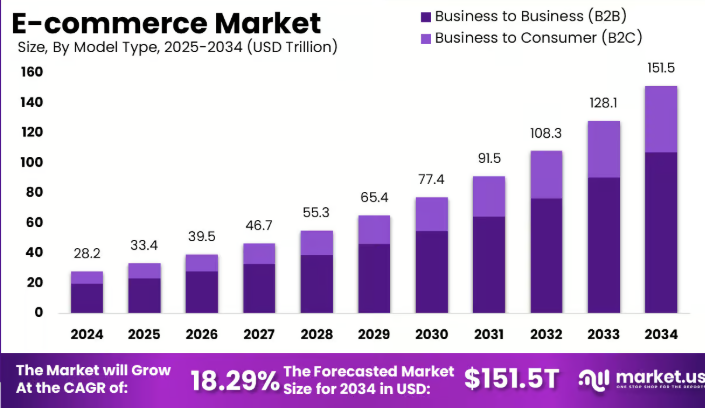
Source – market.us
In today’s AI world starting an online business has been easier now. With just a few clicks you can create a fully functional eCommerce website or store and start selling. But with so many platforms available how do you choose the best eCommerce website builder for your business?
For years, traditional eCommerce store builders have dominated the market. However, with the rise of AI powered eCommerce platform the eCommerce landscape is evolving. AI driven platforms offer automation, smart insights and enhanced customer experiences, features that traditional builders often lack.
So, which one is better? Should you stick with the tried and tested traditional eCommerce platforms or embrace the power of AI? Let’s dive in and compare both to find out which truly wins the battle of the best eCommerce builder.
1. Understanding eCommerce Website Builders
An eCommerce Website creator is platform where businesses are able to create, manage and support an eCommerce website without having a high level of technical knowledge. They provide tools for store design, handling payments, maintaining inventory and marketing products.
There are two main types of ecommerce website maker:
-
Traditional eCommerce Builders - These platforms offer drag and drop features, templates and third party plugins but require manual management.
-
AI Powered eCommerce Website Builders - These use artificial intelligence to automate processes, provide data driven insights and enhance user experiences.
Choosing the best ecommerce website maker depends on your business needs, level of expertise and desire for automation.
Also Read - AI in Ecommerce: A Diginyze Guide.
2. Traditional eCommerce Website Builders: Features and Limitations
What Are Traditional eCommerce Website Builders?
Traditional eCommerce website creators have been the go to options for eCommerce entrepreneurs. They provide user friendly website building tools and integrate with various third-party applications.
Interesting Fact:
An August 2025 survey, conducted by Passport in partnership with Drive Research, focused on 200 worldwide e-commerce industry leaders. The findings revealed that a significant 84% of brands have already integrated Artificial Intelligence (AI) solutions into essential customer-facing operations, such as marketing, personalization efforts and technical support.
Key Features of Traditional eCommerce Website Builders:
-
Drag and Drop Design - Allows easy customization of store layouts.
-
Pre-Built Templates - Offers a variety of themes for different industries
-
Manual SEO Optimization - Users need to handle meta tags, keywords and site speed optimization themselves.
-
Plugin-Based Functionality - Features like email marketing, automation and analytics often require third party apps.
-
Limited AI Capabilities - Most processes, such as customer behavior analysis and inventory management, require manual effort.
Limitations:
-
Time Consuming Management - Requires constant monitoring and manual updates.
-
Higher Dependency on Third Party Apps - Many advanced features are not built-in and require external integrations.
-
Manual SEO Optimization - Users need to handle meta tags, keywords and site speed optimization themselves.
-
Lack of Data Driven Insights - No AI driven recommendations for pricing, inventory or customer engagement.
While traditional eCommerce platforms are reliable and widely used, they may not always be the best eCommerce platforms for businesses looking to scale efficiently.
3. AI-Powered eCommerce Website Builders: Features and Advantages
What Are AI-Powered eCommerce Website Builders?
AI eCommerce Website builders apply artificial intelligence to maximize and automate various aspects of online selling. AI eCommerce website makers provide smarter insights, personalized buyer experiences and enhanced efficiency.
Key Advantages of AI-Powered eCommerce Builders:
-
AI-Driven Insights - Analyzes customer behavior, predicts trends and recommends strategies for better sales.
-
Automated SEO Optimization – AI-powered marketing and SEO offer keyword recommendations, optimize content and boost search rankings without human effort
-
Personalized Shopping Experiences - AI insight provides product recommendations based on customer preferences to increasing conversion rates.
-
Smart Inventory Management - AI Automatically adjusts stock levels based on demand forecasts.
-
Marketing Automation - AI driven tools manage email campaigns, social media ads and chatbot support without human intervention.
Also Read: Want to Be the Next Amazon? AI-Driven Recommendation Engine is the Key
Why AI-Powered eCommerce Builders Are the Future?
AI eliminates guesswork, making online store management easier and more profitable. With automation and data-driven decisions, AI-powered platforms can enhance customer engagement, reduce costs and maximize efficiency making them strong contenders for the best eCommerce platform title.
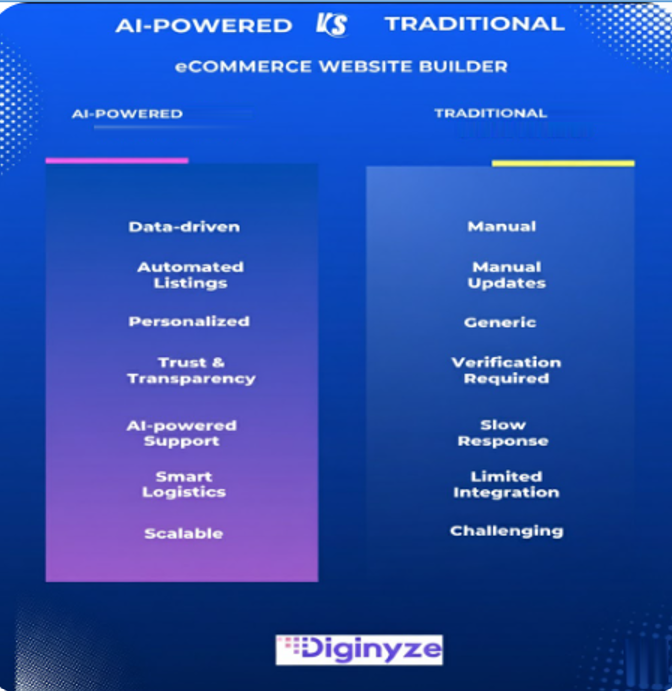
4. AI vs Traditional eCommerce Website Builders: Key Differences
When choosing between an AI-powered and a traditional eCommerce platform, consider these critical differences:
-
Ease of Use: Traditional platforms require manual setup, while AI driven platforms offer automated assistance and intelligent recommendations.
-
SEO and Marketing: Traditional eCommerce website builders need manual keyword optimization and content planning, while AI platforms automate SEO and marketing strategies.
-
Product Recommendations: Traditional platforms rely on static recommendations, whereas AI-powered eCommerce builders analyze user behavior for dynamic personalized suggestions.
-
Customer Analytics: AI powered platform offer deep insights into customer behavior for helping businesses make data driven decisions.
-
Inventory Management: Traditional platforms require manual inventory tracking, whereas AI automates restocking based on demand predictions.
Also Read: AI vs Traditional: Which eCommerce Platform is Best for Startups?
5. Elevating Your Business with Next-Gen AI
The future of eCommerce is undoubtedly intelligent. As technology evolves, adopting a holistic, AI-first approach is essential for staying competitive. Platforms that successfully integrate Artificial Intelligence are moving beyond basic website creation to become intelligent ecosystems that automate, optimize and scale a business across every customer touchpoint.
For example, a platform designed for this future, like Diginyze an AI-powered eCommerce platform, stands out by leveraging cutting edge AI and Machine Learning (ML) to provide:
-
Hyper-Personalized Customer Experiences
-
Intelligent Automation Suite (from inventory to marketing)
-
AI-Powered Analytics (delivering actionable business intelligence)
-
Unified Omnichannel Commerce
These features move far beyond what a traditional builder can offer, ensuring maximum efficiency and minimal effort.
Conclusion
As eCommerce continues to evolve, the choice between an AI-powered and a traditional eCommerce website builder becomes more significant for long-term growth.
| Platform Type | Key Takeaway | Best For |
|---|---|---|
| Traditional Platforms | Offer manual control but require constant oversight and reliance on numerous third-party integrations to accomplish tasks. | Smaller businesses with limited budgets and straightforward needs. |
| AI-Powered Platforms | Provide unmatched automation, smarter data-driven insights, and personalized customer experiences. | Small, Mid, and Big Businesses focused on scaling, efficiency and maximizing customer engagement. |
If you are serious about growing your online business with minimal manual effort and maximum efficiency, adopting AI is the future. The question is not whether AI will take over eCommerce it’s whether your business will be ready for it.
Ready to experience the power of AI in eCommerce? Explore Diginyze and take your online store to the next level. Book a free demo now!
Related Blogs
AI in B2B eCommerce: Transforming Lead Generation Tactics



Recent Blogs
The latest insight into technology and Ecommerce
AI Chatbot for eCommerce: The 24/7 Strategy to Drive 70%+ Conversions and Scale
Did you know? 71% of Gen Z customers buy items via chatbots and 40% of customers use retail digital assistants.
KNOW MORE
AI for Small Retailers: How to Thrive in the E-Retail Revolution
Did you know that U.S. eCommerce sales are expected to hit a record $1.192 trillion in this year, up from $571 billion in 2019?
KNOW MORE
AI-Powered vs. Traditional eCommerce Website Builder: Don’t Get Left Behind!
Choosing the right eCommerce Website Builder is crucial for any eCommerce business.
KNOW MORE
Why Top U.S. Enterprises Are Ditching Legacy eCommerce for AI-First Platforms Like Diginyze
Did you know that U.S. eCommerce sales crossed $1.1 trillion in 2024, yet over 64% of enterprise brands say .....
KNOW MORE
How AI Personalization is Driving a 25% Sales Surge
Did you know? AI-powered search functionalities can increase eCommerce conversion rates by up to 43%, significantly enhancing the efficiency of online shopping platforms. In today's fast-paced eCommerce world, time is of the essence. Customers are no longer willing to sift through endless pages of products just to find what they’re looking for.
KNOW MORE
AI Overviews are Killing Your Traffic: What to do in 2026 and Beyond
Google’s AI Overviews are reshaping search visibility in 2026, causing traffic drops across eCommerce.
KNOW MORE

Advanced AI Security for your Online Store by Diginyze
Cyber Security
Diginyze: Discover the Future of eCommerce Analytics
Futurism AI
AI-Driven eCommerce Marketing with Diginyze
eCommerce
Power your eCommerce Store with Diginyze’s AI-Powered Search & Discovery
Futurism AI
Diginyze: AI-Powered Intelligent eCommerce Platform
eCommerce
Futurism AI: Pioneering
01 Sep 2024
Telecom Transformation: AI Solutions for Call Drops & Billing Woes
Futurism AI
Futurism AI: Tackling Churn and Sustainability for Telcos
Futurism AI
WormGPT Exposed: Decoding the New AI-Driven Cyber Threat
Cyber Security
Futurism DevOps: Unlock DevOps Excellence
Futurism DevOps
Futurism IoT: The Power of Connectivity Awaits!
Futurism IoT:Case Studies




Your Digital Transformation Starts Here!
Join thousands of businesses transforming with Diginyze. Sign up today and start now!