

How Managed Hosting Supports Omnichannel and Multi-Store eCommerce Growth

-
Author Diginyze
-
Published July 31, 2026
-
2 comments Join the Conversation


Do you want your eCommerce business to be found, convert, and scale across every channel and storefront your customers use? Read on to find out how.
Today, shoppers don’t just browse one website; they expect a unified experience whether they are on your mobile app, desktop store, physical location, social commerce page, or marketplace listing. Omnichannel and multi-store strategies are no longer nice-to-haves they are table stakes for growth.
Yet many businesses hit a wall when scaling: slow load times during peak traffic, inconsistent inventory across stores, security headaches, and mounting hosting costs that don’t deliver proportional performance.
That’s where managed eCommerce hosting changes the game. It provides the reliable, scalable foundation your eCommerce platform needs to support omnichannel eCommerce and multi-store eCommerce without the operational chaos.
In this guide, you’ll discover exactly how it works, why it outperforms traditional setups, and how to make it work for your business.
Key Takeaways
-
Omnichannel shoppers spend 3-4x more annually than single-channel customers, with strong programs driving up to 89% retention rates versus 33% for weaker ones.
-
Managed eCommerce hosting delivers auto-scaling, expert optimization, and 24/7 support that keeps multi-store operations fast and reliable during traffic spikes.
-
Traditional hosting often leads to downtime, security gaps, and manual headaches that kill conversions and slow expansion.
-
Scalable managed hosting reduces costs long-term while enabling faster launches of new stores and channels.
-
Businesses using robust infrastructure see measurable lifts in performance, SEO, and revenue.
Why Your Omnichannel and Multi-Store eCommerce Strategy Is Struggling to Scale
Omnichannel retail continues its explosive growth. The market is projected to expand significantly through 2033 at strong CAGRs, as brands race to meet customer demands for seamless experiences.
But growth brings complexity:
-
Inventory and data silos: Real-time stock visibility across online stores, apps, physical locations, and third-party channels is tough without unified systems.
-
Performance inconsistencies: One store loads lightning-fast while another lags, hurting user experience and SEO.
-
Traffic unpredictability: Flash sales, holidays, or viral campaigns cause crashes on under-provisioned servers.
-
Security and compliance risks: Handling payments across multiple touchpoints increases PCI compliance burdens.
-
Resource drain: Launching and managing multiple branded or regional stores strains internal teams without proper infrastructure.
-
Integration headaches: An eCommerce connector enables seamless integration of CRMs, ERPs, marketplaces, and frontends with robust backend support.
These issues don’t just frustrate customers; they directly impact revenue through abandoned carts, lost sales, and damaged trust. Many enterprises discover too late that their eCommerce website hosting can’t keep pace.
What Is Managed eCommerce Hosting (and Why It Matters)
Managed eCommerce hosting is a full-service solution where experts handle your server infrastructure, security, performance optimization, scaling, and maintenance, so you focus on growing your business.
Unlike traditional or self-managed hosting, it’s purpose-built for the demands of modern eCommerce platforms. Think auto-scaling resources, advanced caching, global CDN integration, proactive monitoring, and dedicated support tailored for high-traffic online stores.
For multi-store eCommerce, this means centralized control with the flexibility to run separate branded sites, or B2B/B2C divisions.
For omnichannel eCommerce, it ensures consistent speed, uptime, and data sync across every customer touchpoint.
How Managed Hosting Powers Omnichannel and Multi-Store Success
Here’s how the right hosting infrastructure directly supports your growth:
1. Seamless Scalability for Multi-Store Operations
Launching a new store? Expanding internationally?
Managed hosting lets you spin up additional storefronts quickly with shared or dedicated resources that scale automatically. No more provisioning servers manually or worrying about downtime during rollouts.
2. Unified Performance Across Channels
Fast, reliable eCommerce website hosting ensures every channel, including web, mobile, and in-store kiosks, delivers excellent Core Web Vitals. This boosts SEO rankings, conversion rates, and customer satisfaction.
3. Reliable High-Traffic Handling
Auto-scaling handles Black Friday surges or unexpected demand without performance dips. Your eCommerce platform stays online and responsive.
4. Enhanced Security and Compliance
Built-in protections like DDoS mitigation, firewalls, automatic updates, and PCI-compliant setups reduce risks, which is critical when managing payments across multiple stores and channels.
5. Easier Integrations and Data Management
Robust infrastructure supports real-time syncs for inventory, orders, and customer data, solving one of the biggest omnichannel pain points.
Why Scalable Managed Hosting Is Better Than Traditional Hosting
Traditional hosting starts cheap but becomes expensive and risky as you grow:
-
Limited resources lead to slowdowns or crashes.
-
You handle security patches, updates, and optimizations yourself (or pay premium for ad-hoc help).
-
Scaling requires manual intervention and downtime risks.
-
Poor support during critical periods.
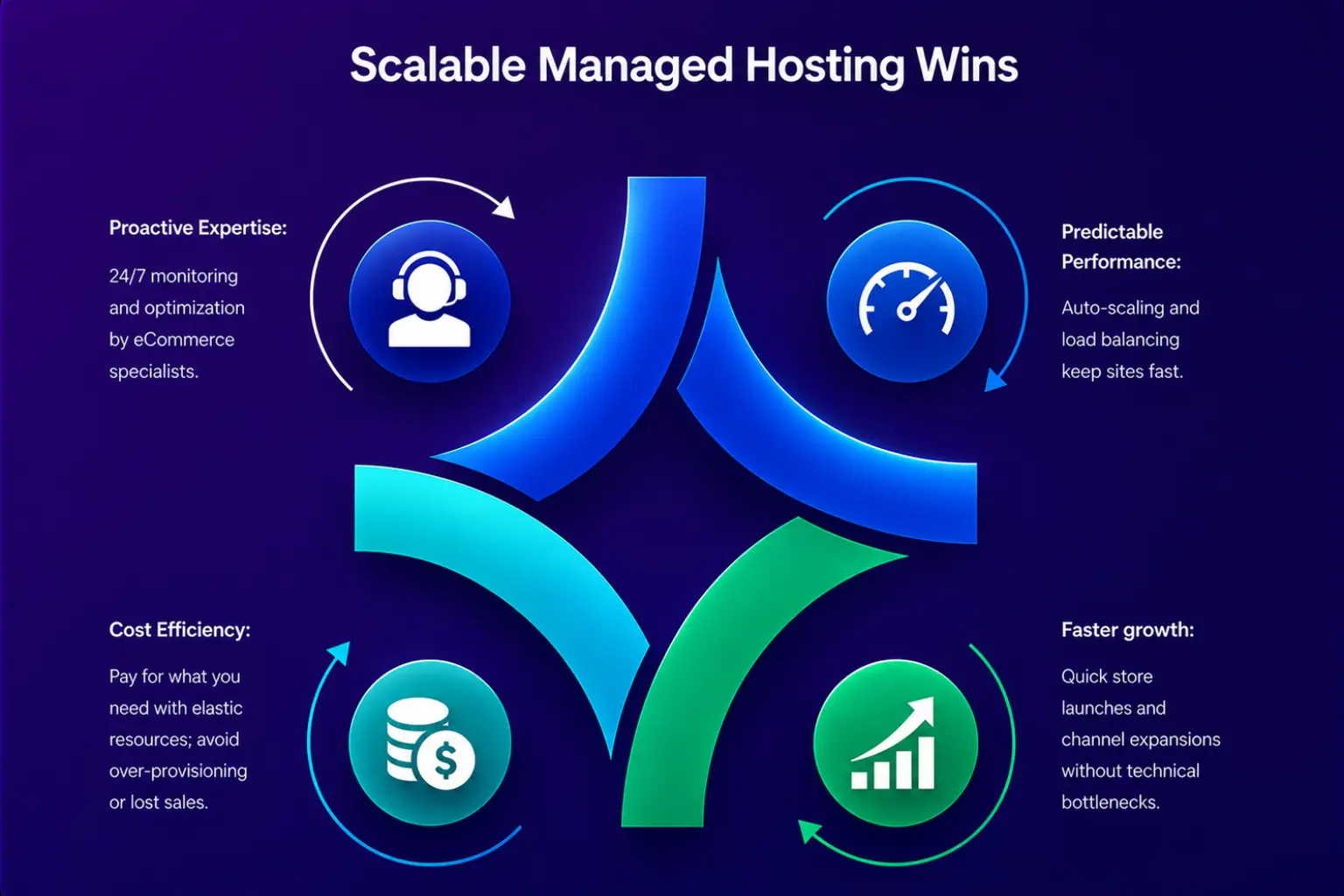
Scalable managed hosting wins because:
-
Proactive expertise: 24/7 monitoring and optimization by eCommerce specialists.
-
Predictable performance: Auto-scaling and load balancing keep sites fast.
-
Cost efficiency in the long-term: Pay for what you need with elastic resources; avoid over-provisioning or lost sales.
-
Faster growth: Quick store launches and channel expansions without technical bottlenecks.
For enterprises and growing businesses alike, the ROI is clear: higher uptime, better conversions, and more time for strategy.
Steps to Upgrade Your Hosting for Omnichannel Growth
-
Audit your current setup: Check uptime, load times, scalability during peaks, and pain points with multi-store management.
-
Define your growth roadmap: How many stores/channels? Peak traffic expectations? International needs?
-
Choose a managed provider: Look for eCommerce expertise, clear SLAs, and proven multi-store/omnichannel case studies.
-
Migrate strategically: With minimal downtime and data integrity.
-
Optimize continuously: Leverage monitoring tools and expert recommendations.
The Future of Hosting for Omnichannel and Multi-Store eCommerce
The brands that win in the next 12–24 months won’t just manage more stores and channels; they’ll run them on infrastructure built for what’s coming next.
Here are the four hosting trends every enterprise should watch:
1. Headless Commerce Goes Mainstream
Decoupled architectures are becoming the standard. Managed hosting optimized for headless commerce delivers fast APIs, seamless microservices, and the flexibility to launch new stores quickly without rebuilding your entire platform.
2. AI-Driven Optimization at Scale
Real-time personalization, dynamic pricing, and predictive tools require serious backend power. Future-ready managed hosting supports AI workloads with auto-scaling compute, keeping your sites fast even as intelligence layers grow.
3. Edge Computing + Advanced Global CDNs
Shoppers expect sub-second experiences everywhere. Edge computing and next-gen CDNs reduce latency, improve global performance, and boost resilience for multi-store and omnichannel operations.
4. Sustainability and Green Hosting
Eco-conscious consumers and investors are watching. Leading providers now offer carbon-aware, energy-efficient infrastructure that aligns performance with environmental responsibility without compromise.
Brands that adopt them through robust managed eCommerce hosting will move faster, personalize better, and build stronger customer loyalty.
How Does Managed Hosting Make Launching and Managing Multiple Stores Easier?
Managed eCommerce hosting is designed specifically for omnichannel and multi-store success:
-
Rapid multi-store deployment: Pre-configured environments and templates let you launch new stores in record time while maintaining brand consistency.
-
Centralized management dashboard: Control multiple storefronts, monitor performance, and manage resources from one place.
-
Optimized for leading platforms: Seamless support for major eCommerce platforms with custom configurations for your needs.
-
Auto-scaling and global reach: Handle traffic spikes and serve international customers with low latency via CDN.
-
Dedicated support: The hosting team acts as an extension of yours, providing proactive alerts, performance tuning, and strategic guidance.
-
Security-first approach: Enterprise-grade protections keep your data and customer transactions safe across all stores.
Choosing the right hosting platform is critical for multi-store growth, as it provides the scalability, reliability, and seamless store management needed for long-term success.
Ready to Power Your Omnichannel and Multi-Store Future?
Omnichannel and multi-store eCommerce represent massive opportunities, but only if your infrastructure can support them. Managed eCommerce hosting removes the barriers, letting you focus on what matters: delivering exceptional customer experiences and driving revenue.
Whether you’re a small business launching your first additional store or an enterprise optimizing a complex portfolio, the right hosting foundation makes all the difference.
Ready to Scale Your Omnichannel Business?
As your business expands across multiple stores, regions, and channels, operational complexity grows just as fast.
Diginyze helps simplify that complexity with a unified commerce platform that connects eCommerce, CRM, ERP, marketing, analytics, and automation in one place.
Schedule a personalized demo today and discover how Diginyze can streamline operations, improve customer experiences, and support long-term growth.
FAQs
What is managed eCommerce hosting?
Managed eCommerce hosting is a comprehensive service where experts manage your server infrastructure, security, performance, scaling, and maintenance so your online store runs optimally without requiring in-house server expertise.
Why is scalable managed hosting better than traditional hosting?
Scalable managed hosting offers auto-scaling, proactive optimization, expert support, and better security, reducing downtime, costs from lost sales, and manual work compared to traditional setups that require more hands-on management and struggle with growth.
Does managed hosting support omnichannel eCommerce?
Yes. It ensures fast, reliable performance and real-time data synchronization across web, mobile, social, marketplaces and physical channels for a seamless customer journey.
How much does managed eCommerce hosting cost?
Pricing varies based on traffic, resources, and features, but it often delivers strong ROI through higher uptime, improved conversions, and reduced internal IT costs compared to self-managed alternatives.
managed hosting suitable for small businesses or only enterprises?
It benefits businesses of all sizes. Small and mid-sized companies gain enterprise-level reliability without the overhead, while larger organizations get specialized scaling support.
What security features come with managed hosting?
Typical features include PCI compliance support, DDoS protection, firewalls, automatic updates, regular backups, and continuous monitoring.
How quickly can I migrate to managed hosting?
With proper planning, migrations can often be completed with minimal downtime, frequently in days or weeks depending on complexity.




Recent Blogs
The latest insight into technology and Ecommerce
AI Chatbot for eCommerce: The 24/7 Strategy to Drive 70%+ Conversions and Scale
Did you know? 71% of Gen Z customers buy items via chatbots and 40% of customers use retail digital assistants.
KNOW MORE
AI for Small Retailers: How to Thrive in the E-Retail Revolution
Did you know that U.S. eCommerce sales are expected to hit a record $1.192 trillion in this year, up from $571 billion in 2019?
KNOW MORE
AI-Powered vs. Traditional eCommerce Website Builder: Don’t Get Left Behind!
Choosing the right eCommerce Website Builder is crucial for any eCommerce business.
KNOW MORE
Why Top U.S. Enterprises Are Ditching Legacy eCommerce for AI-First Platforms Like Diginyze
Did you know that U.S. eCommerce sales crossed $1.1 trillion in 2024, yet over 64% of enterprise brands say .....
KNOW MORE
How AI Personalization is Driving a 25% Sales Surge
Did you know? AI-powered search functionalities can increase eCommerce conversion rates by up to 43%, significantly enhancing the efficiency of online shopping platforms. In today's fast-paced eCommerce world, time is of the essence. Customers are no longer willing to sift through endless pages of products just to find what they’re looking for.
KNOW MORE
AI Overviews are Killing Your Traffic: What to do in 2026 and Beyond
Google’s AI Overviews are reshaping search visibility in 2026, causing traffic drops across eCommerce.
KNOW MORE

Advanced AI Security for your Online Store by Diginyze
Cyber Security for eCommerce
Diginyze: Discover the Future of eCommerce Analytics
Diginyze eCommerce Analytics
AI-Driven eCommerce Marketing with Diginyze
eCommerce
Diginyze's AI Search for eCommerce Store
AI in eCommerce
Diginyze's AI-Powered Intelligent eCommerce Platform
AI-Powered eCommerceDiginyze's AI-Native eCommerce for B2B, B2C & Marketplaces
AI-Native eCommerceCase Studies




Your Digital Transformation Starts Here!
Join thousands of businesses transforming with Diginyze. Sign up today and start now!