

Why Your Brand Needs a Quick Commerce Platform Now

-
Author Diginyze
-
Published April 28, 2026
-
2 comments Join the Conversation


The Rise of 10 Minutes Delivery Retail Revolution
Today, waiting two days for a delivery feels like waiting a lifetime. We’ve officially entered the era of the "I need it now" economy.
If you’re a retail executive, a startup founder, or a brand manager in the FMCG space, you’ve likely watched the meteoric rise of Quick Commerce (Q-commerce). What started as a niche convenience for urban millennials has exploded into a global phenomenon, redefining the very fabric of the supply chain. We aren't just talking about getting a pizza in 30 minutes anymore, we’re talking about getting your organic almond milk, a new charging cable, or high-end lipstick at your doorstep in under 10 minutes.
But is this just a passing trend fueled by VC money, or is it a structural shift in how user shop? Let’s dive into the mechanics of Q-commerce and why your business needs a robust quick commerce platform to stay relevant.
What Exactly is Quick Commerce?
Quick Commerce is the third generation of commerce.
-
Traditional Retail: You go to the store.
-
eCommerce: The store comes to you in 2–5 days.
-
Quick Commerce: The store is already in your neighborhood, and it’s at your door before you’ve finished your coffee.
Q-commerce relies on a decentralized network of dark stores (micro-fulfillment centers not open to the public) and sophisticated AI-driven logistics. By placing inventory just 1–3 miles away from the end consumer, brands can slash delivery times from days to mere minutes.
Explosive Growth:
A ccording to recent industry data, the global quick commerce market is projected to grow from $129.73 billion in 2025 to $161.93 billion in 2026, sporting a massive compound annual growth rate (CAGR) of 24.8%.
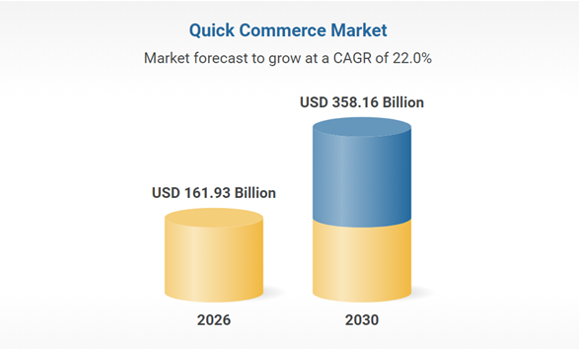
Source: Research and Markets
Real-World Winners:
1. The Urban Pivot: DoorDash and DashMart
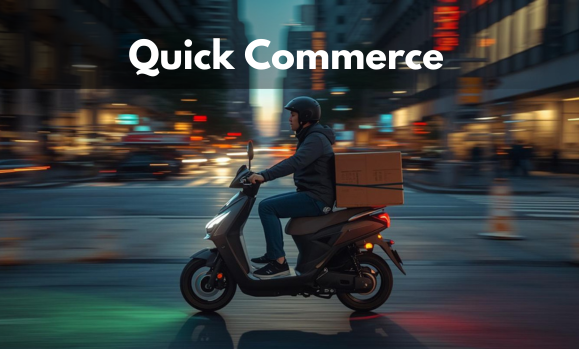
DoorDash didn't just stop at restaurant delivery. By launching DashMarts, their version of dark stores, they’ve successfully pivoted into a quick commerce powerhouse. In cities like New York and Chicago, a user can order a single bag of flour or a COVID-19 test kit and have it delivered in 12 minutes. They aren't just a delivery app, they are a hyperlocal infrastructure company.
2. The Grocery Revolution: Instacart’s 15-Minute Flight
Instacart has moved beyond the "personal shopper" model for massive weekly hauls. By partnering with major retailers to utilize their front-of-house space as micro-hubs, they now offer "Ready in 15" services. This allows FMCG brands to capture the "impulse buy" market that was previously lost to the local 7-Eleven.
Did you know? North America currently dominates this space, holding a 33.43% market share as of late 2025, driven by a relentless demand for ultra-fast grocery and essential deliveries.
The Hard Truth: 10-Minute Delivery Sounds Great, But Execution Is Everything
Here’s where many businesses get it wrong:
They think quick commerce is just a faster checkout plus delivery riders.
It is not.
A quick commerce operation only works when these five things are under control:
-
Inventory accuracy: If stock data is wrong, speed means nothing.
-
Fulfillment density: You need enough local order volume to make delivery economics work.
-
Smart dispatching: Manual assignment kills scale.
-
Customer experience: Fast delivery with poor visibility still feels broken.
-
Operational intelligence: Without forecasting, routing and performance analytics, margins disappear fast.
That is why the market is shifting toward AI-powered systems. Speed without intelligence is expensive. Speed with intelligence becomes scalable.
The Anatomy of a High-Performing Quick Commerce Platform
To win in this space, you can’t just "bolt on" a delivery driver to your store. You need a dedicated quick commerce platform designed for speed, precision, and AI-driven efficiency.
Here is what the "gold standard" looks like:
1. Hyper-Local Inventory Management
You can't deliver in 10 minutes if your system doesn't know exactly what's on the shelf at the dark store on 5th Avenue. A true quick commerce platform provides real-time, bin-level accuracy across hundreds of micro-hubs.
2. AI-Driven Demand Forecasting
In quick commerce, "Out of Stock" is a death sentence. Top-tier platforms use Artificial intelligence demand planning to predict localized trends with surgical precision. For example, if it’s raining in Seattle, the system anticipates a spike in demand for hot chocolate and umbrellas over the next two hours, triggering an automatic stock replenishment before the surge even begins. By aligning inventory with real-time environmental data, you ensure that "instant" delivery is always a promise kept.
3. Smart Dispatch and Routing
Seconds matter. Your platform must automatically assign orders to the nearest courier based on traffic patterns, bike-lane availability, and even building entry codes.
Why Quick Commerce Matters to Your Business
For Retail Executives and Owners
Quick commerce creates a new way to defend local market share.
If your customer can get the same basket from another app in 15 minutes, loyalty becomes fragile. A smart quick commerce strategy helps retailers stay relevant, especially in high-frequency categories like grocery, convenience, pharmacy, beauty, and household essentials.
It is not only about speed. It is about keeping the customer relationship instead of handing it over to third-party marketplaces.
For FMCG Brand Managers
Q-commerce shortens the distance between intent and purchase.
That is powerful for FMCG brands because it increases the chance of impulse buying, repeat buying, and replenishment. If your products are available when the need happens, your brand becomes the easiest choice and often the default one.
It also opens the door to hyperlocal promotions, real-time offers, and location-based merchandising.
For Startup Founders
Quick commerce is still full of opportunity but only if the model is built on smart economics, not just speed theater.
The winners will not be the brands promising the flashiest delivery times. The winners will be the ones that build efficient local fulfillment, healthy repeat-order behavior, and strong retention loops.
For Investors
This space is maturing. That matters.
The conversation is moving from “Can this grow?” to “Can this scale profitably?” The strongest businesses will likely be the ones with better inventory intelligence, tighter fulfillment density, stronger unit economics, and smarter platform infrastructure.
Conclusion:
The rise of 10-minute delivery isn't just about speed, it's about reclaiming the consumer's time. In a world where attention is the scarcest resource, being the fastest brand in the neighborhood is the ultimate competitive advantage.
To scale in this environment, you need more than just a website, you need an ecosystem. Diginyze is an all-in-one, AI-powered quick commerce platform specifically designed to help U.S. brands launch dark stores, optimize last-mile delivery, and master hyperlocal fulfillment.
Whether you’re a startup looking to disrupt or an established FMCG brand looking to defend your turf, we have the features to make "instant" your new reality.
Ready to lead the Quick Commerce revolution?
Stop guessing and start delivering.
Book a Free Demo with Diginyze and see how our AI-driven eCommerce platform can put your products in your customers' hands in minutes.
FAQs:
1. What is a quick commerce platform and how does it differ from standard eCommerce?
A quick commerce platform is specialized software designed for ultra-fast fulfillment (typically 10-30 minutes). Unlike standard eCommerce, which centralizes stock in large warehouses, Q-commerce platforms manage a decentralized network of "dark stores" or micro-fulfillment centers. They prioritize hyperlocal logistics, real-time inventory precision, and rapid rider dispatching.
2. How do dark stores power the 10-minute delivery model?
Dark stores are small, local distribution hubs located in high-density urban areas. They are not open to the public and are optimized solely for picking and packing speed. By holding inventory just a few miles from the customer, a quick commerce platform can reduce the "last-mile" travel time to under 10 minutes.
3. Is quick commerce profitable for FMCG brands in the U.S.?
Yes, if managed through an AI-powered platform. While the delivery costs are higher, Q-commerce significantly increases purchase frequency and customer loyalty. AI helps maintain profitability by optimizing rider routes and using predictive analytics to reduce waste and overstocking in dark stores.
4. What are the key features to look for in a quick commerce platform?
The "must-haves" include real-time hyperlocal inventory sync, AI-driven demand forecasting, automated order triaging and a dedicated courier management interface. Integration with your existing ERP and POS systems is also vital for seamless operations.
5. How does AI improve last-mile delivery in quick commerce?
AI analyzes variables like live traffic, weather conditions, and rider availability to calculate the most efficient route. It also predicts "order density" in specific neighborhoods, allowing businesses to pre-stage high-demand inventory closer to the customer before the order is even placed.
6. Can existing retail stores be converted into quick commerce hubs?
Absolutely. Many retailers use a "hybrid" model where a section of their physical store is cordoned off as a micro-fulfillment center. A robust quick commerce platform like Diginyze can manage this inventory separately to ensure in-store shoppers and online orders don't conflict.
7. What is the future of quick commerce in 2026 and beyond?
The industry is moving toward "Instant Everything." While it started with groceries, we see a massive shift into pharmacy, electronics, and high-end fashion. The integration of autonomous delivery bots and drones is also expected to further reduce operational costs.

Recent Blogs
The latest insight into technology and Ecommerce
AI Chatbot for eCommerce: The 24/7 Strategy to Drive 70%+ Conversions and Scale
Did you know? 71% of Gen Z customers buy items via chatbots and 40% of customers use retail digital assistants.
KNOW MORE
AI for Small Retailers: How to Thrive in the E-Retail Revolution
Did you know that U.S. eCommerce sales are expected to hit a record $1.192 trillion in this year, up from $571 billion in 2019?
KNOW MORE
AI-Powered vs. Traditional eCommerce Website Builder: Don’t Get Left Behind!
Choosing the right eCommerce Website Builder is crucial for any eCommerce business.
KNOW MORE
Why Top U.S. Enterprises Are Ditching Legacy eCommerce for AI-First Platforms Like Diginyze
Did you know that U.S. eCommerce sales crossed $1.1 trillion in 2024, yet over 64% of enterprise brands say .....
KNOW MORE
How AI Personalization is Driving a 25% Sales Surge
Did you know? AI-powered search functionalities can increase eCommerce conversion rates by up to 43%, significantly enhancing the efficiency of online shopping platforms. In today's fast-paced eCommerce world, time is of the essence. Customers are no longer willing to sift through endless pages of products just to find what they’re looking for.
KNOW MORE
AI Overviews are Killing Your Traffic: What to do in 2026 and Beyond
Google’s AI Overviews are reshaping search visibility in 2026, causing traffic drops across eCommerce.
KNOW MORE

Advanced AI Security for your Online Store by Diginyze
Cyber Security
Diginyze: Discover the Future of eCommerce Analytics
Futurism AI
AI-Driven eCommerce Marketing with Diginyze
eCommerce
Power your eCommerce Store with Diginyze’s AI-Powered Search & Discovery
Futurism AI
Diginyze: AI-Powered Intelligent eCommerce Platform
eCommerce
Futurism AI: Pioneering
01 Sep 2024
Telecom Transformation: AI Solutions for Call Drops & Billing Woes
Futurism AI
Futurism AI: Tackling Churn and Sustainability for Telcos
Futurism AI
WormGPT Exposed: Decoding the New AI-Driven Cyber Threat
Cyber Security
Futurism DevOps: Unlock DevOps Excellence
Futurism DevOps
Futurism IoT: The Power of Connectivity Awaits!
Futurism IoT:Case Studies




Your Digital Transformation Starts Here!
Join thousands of businesses transforming with Diginyze. Sign up today and start now!