

How to Drive 30% Faster eCommerce Growth with Legacy AI Integration

-
Author Diginyze
-
Published April 17, 2026
-
2 comments Join the Conversation


Introduction
Your legacy systems like ERP and other core tools aren’t just sitting there collecting dust, they’re quietly draining revenue. Orders get stuck, inventory numbers don’t match reality, marketing moves at a snail’s pace, and customers start shopping somewhere else.
Sound familiar?
52% of U.S. eCommerce businesses say legacy system delays are the main thing holding back their growth.
The good news:
ou don’t have to rip everything out and start over. Today’s AI-powered eCommerce platforms connect smoothly with your existing systems, automate the boring stuff, and deliver real-time insights that move the needle.
In this blog, we’ll show you exactly why legacy system integration matters right now, how cloud-based eCommerce and AI integration unlock faster growth, and what to look for in an eCommerce integration platform that scales with your business without the headaches.
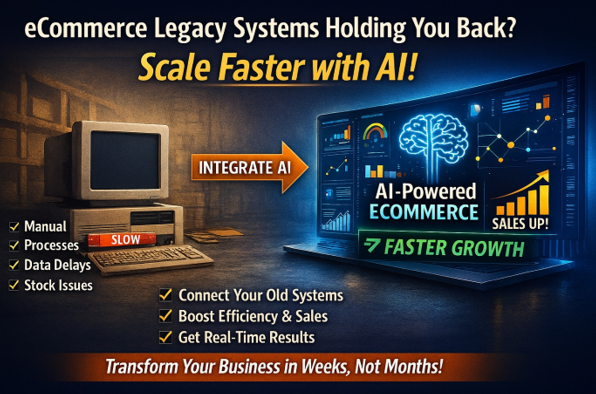
1. Why Outdated Systems Are Slowing Your eCommerce Growth
Most brands didn’t start with a perfect tech stack. They grew from offline roots or basic platforms, and over time it turned into messy patchwork, inventory in one place, orders in another, and customer data scattered everywhere.
Modern buyers expect three things:
-
“Lightning-fast shipping”
-
“Accurate stock levels they can trust”
-
“Personalized recommendations that feel personal”
When your systems don’t talk to each other, you get the following:
-
“Manual errors that cost time and money”
-
“Delayed orders that frustrate customers”
-
“Lost sales because your marketing can’t keep up”
Legacy system integration fixes this. A modern eCommerce integration platform creates real-time data flow so everything stays in sync, leading to fewer mistakes, faster decisions, and happier customers.
2. Cloud eCommerce: Real-Time Data, Zero Headaches
Forget outdated on premise servers that rely on nightly batch updates. Cloud-based eCommerce puts everything online in a secure, scalable setup that just works.
Here’s what changes:
-
“Inventory updates the second a customer hits “Buy”, no more overnight delays”
-
“One central dashboard for your website, marketplaces, social shops, and physical stores”
-
“Automatic scaling so your site never crashes on Black Friday or during a big campaign”
Pro tip:
Cloud infrastructure makes AI integration with your legacy systems way easier. You use simple, standard APIs instead of expensive custom work or a full system replacement.
Retail leaders are already proving this model on scale. Walmart has successfully layered AI onto its legacy supply chain and ERP systems instead of replacing them. By combining cloud infrastructure with AI-driven demand forecasting and real-time inventory visibility, Walmart has significantly improved fulfillment speed, reduced stockouts, and optimized its omnichannel eCommerce operations.
3. AI That Works with Your Legacy Systems (Yes, Really)
Many people think AI means throwing out everything old. Not true.
Your legacy systems are great at storing data, but they’re terrible at using it. They can’t predict what will sell next week or spot a trending product in real time.
Layer on AI-powered eCommerce and suddenly you get:
-
“Predictive inventory that tells you what it’s about to sell out”
-
“Smart product recommendations that feel custom made for each shopper ”
-
“Automated marketing and workflows that run without your team lifting a finger”
This approach isn’t theoretical, it’s how market leaders operate. Amazon has built its dominance on an API-first architecture layered over deeply integrated legacy infrastructure. By embedding AI across recommendation engines, logistics, and warehouse operations, Amazon delivers real-time personalization and unmatched operational efficiency at scale.
Real-world results from brands that made the move: 30% faster operations and 20-25% You keep the systems you already trust and simply add intelligence on top.
4. APIs: The Glue That Makes Everything Talk
Think of APIs as the universal translator between your ERP, inventory software, and eCommerce platform. Without strong API architecture, your systems speak completely different languages.
With the right setup, you get:
-
“Fast connections to new tools, no heavy coding required”
-
“Easy swaps when you want to add or change apps”
-
“Instant sync of orders, stock, and customer data”
-
“Room to grow without rebuilding everything later”
Smart platforms like Diginyze are built API-first. That means they connect your legacy systems, AI features, cloud tools, and third-party apps into one smooth, flexible ecosystem.
5. Overcoming Common Integration Challenges
Many leaders hesitate because of real risks: downtime, disorganized data, team pushback, or security concerns.
Smart brands clear these hurdles with:
-
“Phased rollouts and zero-downtime testing”
-
“Pre-built connectors that reduce manual cleanup”
-
“Enterprise-grade cloud security and compliance tools”
-
“Simple dashboards that help teams see quick wins”
Choose an eCommerce integration platform designed for legacy systems (with ready support for SAP, NetSuite, Dynamics, etc.), and most integrations move from worry to results in weeks, not months.
6. Real Results: What Happens When You Get It Right
The numbers don’t lie. Companies that combine legacy system integration with AI see:
-
“Up to 30% faster order processing and fewer errors”
-
“20-25% reduction in stockouts and overstock”
-
“10-15% lift in average order value through smart personalization”
-
“More time for strategy instead of firefighting”
These gains compound: better data fuels sharper marketing, which drives revenue, which funds further growth all without replacing your core systems.
7. Picking the Platform That Actually Scales Your Business
Not every platform is built for growth. Some force big rewrites. Others lock you into one vendor.
Here’s what growing U.S. brands should demand from their eCommerce integration platform:
-
“1. Easy legacy system integration: Pre-built eCommerce connectors and clean APIs.”
-
“2. Built-in AI power: Predictive analytics and smart recommendations that work out of the box.”
-
“3. Cloud-first design: Handles traffic spikes without breaking a sweat.”
-
“4. Real-time synchronization: Orders, inventory, and marketing data update instantly.”
-
“5. True multi-channel support: Online store, Amazon, Walmart, social commerce, POS system, and mobile apps.”
-
“6. Future-ready architecture: Add new tools and features without costly overhauls.”
Conclusion:
Your legacy systems don’t have to hold you back. With the right mix of cloud-based eCommerce, AI integration, and solid API architecture, you can turn your existing tech into a growth engine, faster decisions, smoother operations, and a real competitive edge.”
Diginyze was built exactly for this, a unified AI-powered eCommerce platform that connects legacy systems, unlocks smart insights, and scales with your business.
Stop watching opportunities slip away.
Book your free demo today and start seeing real-time insights, automation, and measurable growth in just weeks.
Your next level of eCommerce growth is closer than you think.
Quick FAQs:
Can legacy ERP systems really work with AI-powered eCommerce?
Yes. Modern platforms like Diginyze use clean API architecture and cloud tools to connect your older systems to powerful AI. You get real-time order processing, predictive sales insights, and personalized shopping experiences all without touching your current workflows.
How long does integration usually take?
For most small-to-mid-sized businesses, 4-6 weeks. Larger enterprises with complex setups, 10-12 weeks. Platforms with ready-made connectors and strong API support move much faster. Good partners also run continuous testing, so nothing disrupts your daily operations.
What ROI should I expect from legacy system integration with AI?
Businesses typically achieve a strong ROI within 6-12 months of implementing AI-powered ERP integration. Expect 20-25% reduction in operational and order processing costs, 10-15% growth in sales through personalized shopping experiences and significantly improved inventory accuracy.
Related Blogs

The Power of First-Party Data in eCommerce

Next-Level Shopping: Unlocking the Potential of AR in Retail


AI-Driven Search: The New Era of Search in eCommerce
Recent Blogs
The latest insight into technology and Ecommerce
AI Chatbot for eCommerce: The 24/7 Strategy to Drive 70%+ Conversions and Scale
Did you know? 71% of Gen Z customers buy items via chatbots and 40% of customers use retail digital assistants.
KNOW MORE
AI for Small Retailers: How to Thrive in the E-Retail Revolution
Did you know that U.S. eCommerce sales are expected to hit a record $1.192 trillion in this year, up from $571 billion in 2019?
KNOW MORE
AI-Powered vs. Traditional eCommerce Website Builder: Don’t Get Left Behind!
Choosing the right eCommerce Website Builder is crucial for any eCommerce business.
KNOW MORE
Why Top U.S. Enterprises Are Ditching Legacy eCommerce for AI-First Platforms Like Diginyze
Did you know that U.S. eCommerce sales crossed $1.1 trillion in 2024, yet over 64% of enterprise brands say .....
KNOW MORE
How AI Personalization is Driving a 25% Sales Surge
Did you know? AI-powered search functionalities can increase eCommerce conversion rates by up to 43%, significantly enhancing the efficiency of online shopping platforms. In today's fast-paced eCommerce world, time is of the essence. Customers are no longer willing to sift through endless pages of products just to find what they’re looking for.
KNOW MORE
AI Overviews are Killing Your Traffic: What to do in 2026 and Beyond
Google’s AI Overviews are reshaping search visibility in 2026, causing traffic drops across eCommerce.
KNOW MORE

Advanced AI Security for your Online Store by Diginyze
Cyber Security for eCommerce
Diginyze: Discover the Future of eCommerce Analytics
Diginyze eCommerce Analytics
AI-Driven eCommerce Marketing with Diginyze
eCommerce
Diginyze's AI Search for eCommerce Store
AI in eCommerce
Diginyze's AI-Powered Intelligent eCommerce Platform
AI-Powered eCommerceDiginyze's AI-Native eCommerce for B2B, B2C & Marketplaces
AI-Native eCommerceCase Studies




Your Digital Transformation Starts Here!
Join thousands of businesses transforming with Diginyze. Sign up today and start now!