
How Multichannel and Multistore eCommerce Drives 30% Higher Retention in B2B

-
Author Diginyze
-
Published May 05, 2026
-
2 comments Join the Conversation


Introduction
You have repeat buyers, strong customer relationships, and real demand so why is scaling online so hard?
Because your buyers have moved on. According to report, B2B buyers now use at least 7 digital channels before making a purchase decision. If you're only showing up in one place, you're invisible for most of that journey.
The fix comes down to three things: multiple platforms, a multichannel eCommerce strategy, and a multistore eCommerce platform. Here's what each one means and why you need all three.
What Does Selling on Multiple Platforms Actually Mean?
Selling on multiple platforms simply means your products aren't locked inside one digital location. Instead of forcing buyers to come to you, you show up where they already are.
For a U.S.-based industrial supplier, that might look like this:
-
Their own website for direct buyers and branded experience
-
Amazon Business or industry-specific B2B portals for marketplace discovery
-
A private portal for enterprise clients with negotiated pricing
-
A mobile app for field procurement teams who need to reorder on the go
Each of these is a separate platform, and each serves a different segment of your buyer base. The more places you're accessible, the more opportunities you create, it's that simple.
But managing these platforms separately? That's where businesses start drowning in spreadsheets, duplicate SKUs, and pricing inconsistencies. That's where multichannel eCommerce comes in.
What Is Multichannel Ecommerce?
Multichannel eCommerce is the strategy of selling across multiple online channels while delivering a consistent, connected buying experience across all of them.
Think of it this way:
-
A procurement manager finds your product through a marketplace search
-
A VP of Operations places a bulk order directly through your website
-
A field tech reorders supplies through your mobile app
Three different buyers. Three different entry points. One unified system behind the scenes.
The goal isn't just visibility, it's consistency. Your pricing, product information, inventory, and brand experience should be seamless regardless of how or where someone chooses to buy.
Did you know?
Businesses using multichannel eCommerce strategies saw up to 36% higher customer retention compared to single-channel sellers.
Higher retention means lower acquisition costs, stronger lifetime value, and more predictable revenue.
But multichannel alone doesn't solve everything. Managing different business models, customer segments, or regional markets requires another layer of sophistication and that's where a multistore eCommerce platform becomes your biggest asset.
What Is a Multistore eCommerce Platform?
A multistore eCommerce platform lets you run multiple, distinct online stores from a single centralized system.
Each store can look different, serve different customers, offer different pricing, and operate in different regions, but they're all controlled from one dashboard.
Here's a real-world example: A B2B manufacturer operating in the U.S. might run:
| Store | Audience | Purpose |
|---|---|---|
| Store 1 | U.S. distributors | Standard catalog, volume pricing |
| Store 2 | International buyers | Localized currencies, region-specific SKUs |
| Store 3 | Wholesale clients | Tiered pricing, minimum order quantities |
| Store 4 | Enterprise accounts | Custom contracts, private catalogs |
All four stores have unique branding and buyer experience, but inventory, orders, and product updates are managed centrally. No duplicated effort. No version control nightmares. No "which system has the latest pricing?" chaos.
Think of it as running four businesses with the operational overhead of one.
Multichannel vs. Multistore: What's the Difference?
These two terms get confused constantly even by people who've been in eCommerce for years. Here's the clearest way to think about it:
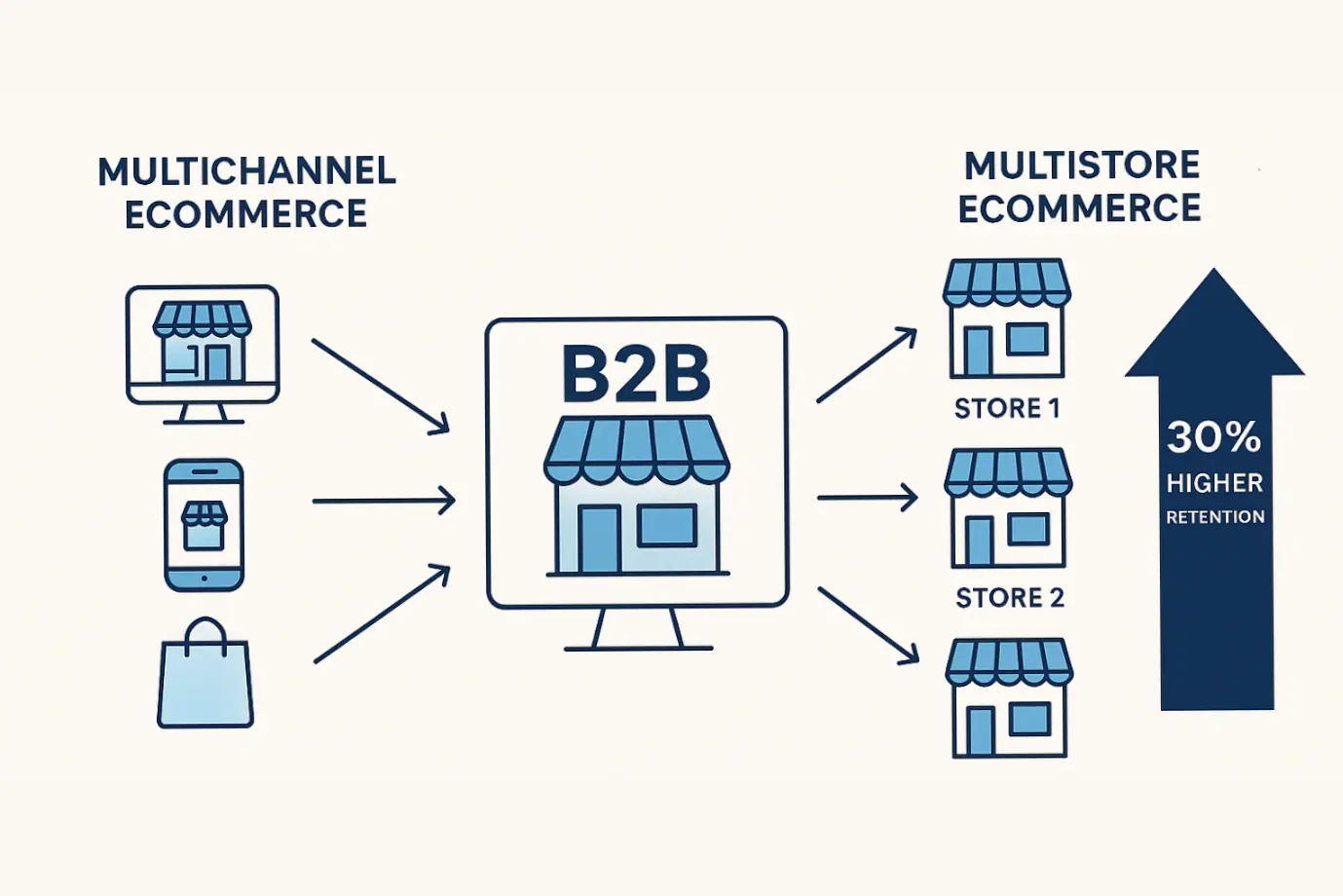
Multichannel eCommerce = WHERE you sell (Your website, marketplaces, mobile apps, social commerce)
Multistore eCommerce platform = HOW you manage different stores (Different brands, regions, customer segments, all in one system
One is about reach. The other is about control. And for growing B2B companies, you need both.
Why B2B Companies in the U.S. Can't Afford to Ignore This
The B2B buying experience has been radically consumerized. Enterprise decision-makers expect the same convenience, personalization, and speed from their business purchases that they get from Amazon on a Saturday afternoon.
If your digital infrastructure can't deliver on that expectation, here's what happens:
-
Buyers Are Everywhere and Impatient: Your customers aren't waiting at your website. They're searching, comparing, and buying across multiple touchpoints. If you're not present at each one, someone else is.
-
One Size Fits Nobody: A regional contractor and a Fortune 500 procurement team have completely different needs, different catalogs, pricing structures, approval workflows, and purchase volumes. A single storefront can't serve both well.
-
Global Expansion Requires Local Flexibility: Selling in multiple U.S. regions, or internationally, means dealing with different currencies, tax rules, shipping logistics, and product availability. A rigid single-store setup makes this a nightmare.
-
Your Competitors Are Already Moving: B2B companies that have invested in multichannel eCommerce and multistore infrastructure are winning deals faster, retaining customers longer, and scaling without proportionally scaling their ops teams.
The Real Business Benefits:
Here's what combining multiple platforms, multichannel eCommerce, and a multistore eCommerce platform delivers:
Better Reach, More Leads
When your products are discoverable across multiple platforms, not just your own website, you significantly increase your total addressable market without a corresponding increase in marketing spend.
Revenue Growth You Can Bank On
U.S. businesses in manufacturing and wholesale that adopted multichannel eCommerce strategies reported revenue growth of 20–35% in recent years. That's not incremental improvement, that's transformational.
Customer Experience That Builds Loyalty
Buyers can purchase from their preferred channel, access custom pricing, and manage their accounts without friction. That seamless experience is what turns buyers into long-term partners.
Centralized Control, Decentralized Execution
Update a product description once, it propagates across all stores and channels automatically. Sync inventory in real time. Track every order from every platform in a single dashboard.
Operational Efficiency That Scales
Instead of maintaining separate systems for each channel or store, you manage everything from one platform. That means fewer errors, faster response times, and a leaner ops team that can focus on growth instead of fire-fighting.
The Challenges (And How a Multistore Platform Solves Them)
Let's be honest, the idea sounds great in theory, but execution is where most businesses stumble. Here are the most common roadblocks, and how the right platform eliminates them:
Challenge: Managing Multiple Disconnected Systems
Running separate backends for each channel leads to data silos, sync errors, and delays.
Solution: A multistore eCommerce platform consolidates everything into one system of record. One login. One dashboard. Full visibility.
Challenge: Inconsistent Pricing and Catalogs
Manually maintaining different price lists for different customer types is a recipe for costly mistakes.
Solution: Create segment-specific stores with custom pricing rules and catalogs built in, no manual overrides required.
Challenge: Inventory Mismatch Across Channels
Overselling on one channel while showing "out of stock" on another kills customer trust fast.
Solution: Centralized inventory management ensures accurate, real-time stock levels across every platform simultaneously.
Challenge: Operational Overwhelm
When orders, returns, and customer data flow in from five different places, your team can't keep up.
Solution: A unified operations dashboard consolidates everything, orders, customers, analytics, in one place. Fewer tools. Less confusion. Faster execution.
What "One Dashboard to Rule Them All" Actually Looks Like
Here's what a modern multistore eCommerce platform enables in practice for a U.S.-based distributor:
-
View and manage orders from Amazon Business, their B2B portal, and direct website all in one place
-
Push product updates once and have them reflected across all stores instantly
-
Set customer-group-specific pricing for wholesale, retail, and enterprise segments without any manual intervention
-
Monitor performance by channel, by store, by region, all from a single analytics view
-
Handle returns and customer service requests from a unified inbox
The result: a leaner operation that scales without adding headcount.
How Diginyze Powers This Entire Strategy
As the B2B eCommerce landscape continues to evolve, businesses need a platform that isn't just powerful, it needs to be practical for the people running it.
Diginyze is purpose-built to support B2B companies looking to scale using multiple platforms, a robust multichannel eCommerce strategy, and a flexible multistore eCommerce platform, without the enterprise-level complexity or cost.
With Diginyze, you can:
-
Manage multiple stores from one centralized system, no switching between platforms
-
Sell across every channel without custom development or integration headaches
-
Customize buying experiences for different customer groups, regions, or brands
-
Streamline operations with centralized inventory, order management, and analytics
-
Scale faster without scaling your overhead
This isn't just technology for its own sake. Its infrastructure is designed to make growth achievable for real business owners and decision-makers.
Final Thoughts:
Having a website is no longer a strategy. It's a starting point.
The B2B companies that will dominate the next decade aren't the ones with the biggest sales teams or the longest client lists. They're the ones that make it frictionless to buy from them on any platform, at any time, through any channel.
Here's the playbook in three moves:
-
Multiple platforms: Expand your presence beyond your own website. Be where your buyers already are.
-
Multichannel eCommerce: Connect those platforms into a unified buying experience that builds trust and drives retention.
-
Multistore eCommerce platform: Manage everything centrally, scale without chaos, and customize every customer segment you serve.
If you're an enterprise decision-maker ready to move beyond single-channel limitations, now is the time to act. Your competitors already have.
Ready to see what this looks like for your business?
Visit diginyze to explore the platform or book a free demo and discover exactly how a smarter eCommerce setup can unlock your next stage of growth.
Frequently Asked Questions
How can B2B businesses grow by selling on multiple platforms?
Selling on multiple platforms allows B2B businesses to reach buyers wherever they are active, whether that's online marketplaces, their company website, or mobile procurement apps. This expands visibility, creates multiple revenue streams, reduces dependency on any one channel, and steadily improves conversion rates by meeting buyers where they already shop.
What is multichannel eCommerce and why does it matter for B2B companies?
Multichannel eCommerce is the practice of selling across multiple digital channels while maintaining consistent, connected customer experience. For B2B companies, it's critical because today's buyers engage with an average of three or more digital touchpoints before making a purchasing decision. A strong multichannel strategy ensures your brand stays accessible, relevant, and competitive throughout that entire journey.
What is a multistore eCommerce platform and how does it work?
A multistore eCommerce platform allows businesses to run multiple distinct online stores from a single backend system. Each store can have its own branding, pricing, product catalog, and target audience while all operations are managed from one centralized dashboard. For B2B companies, this means separate storefronts for wholesale buyers, enterprise clients, and regional markets can all run efficiently without duplicating effort.
What's the difference between multichannel eCommerce and a multistore eCommerce platform?
The difference comes down to focus: multichannel eCommerce is about where you sell (websites, apps, marketplaces), while a multistore eCommerce platform is about how you manage different stores for different audiences or regions. Most scaling B2B businesses need both multichannel for reach, multistore for operational control.
Why should B2B companies prioritize a multistore eCommerce platform?
B2B companies in the U.S. typically serve a diverse mix of customer types, small distributors, large enterprise accounts, regional buyers, international clients each with unique pricing, catalog, and compliance requirements. A multistore eCommerce platform allows companies to serve all these segments effectively from one system, reducing operational complexity while delivering the personalized buying experience each segment expects.
Related Blogs

6 Reasons Manufacturers Need an eCommerce Platform
Future-proofing your eCommerce Business with Diginyze
Recent Blogs
The latest insight into technology and Ecommerce
AI Chatbot for eCommerce: The 24/7 Strategy to Drive 70%+ Conversions and Scale
Did you know? 71% of Gen Z customers buy items via chatbots and 40% of customers use retail digital assistants.
KNOW MORE
AI for Small Retailers: How to Thrive in the E-Retail Revolution
Did you know that U.S. eCommerce sales are expected to hit a record $1.192 trillion in this year, up from $571 billion in 2019?
KNOW MORE
AI-Powered vs. Traditional eCommerce Website Builder: Don’t Get Left Behind!
Choosing the right eCommerce Website Builder is crucial for any eCommerce business.
KNOW MORE
Why Top U.S. Enterprises Are Ditching Legacy eCommerce for AI-First Platforms Like Diginyze
Did you know that U.S. eCommerce sales crossed $1.1 trillion in 2024, yet over 64% of enterprise brands say .....
KNOW MORE
How AI Personalization is Driving a 25% Sales Surge
Did you know? AI-powered search functionalities can increase eCommerce conversion rates by up to 43%, significantly enhancing the efficiency of online shopping platforms. In today's fast-paced eCommerce world, time is of the essence. Customers are no longer willing to sift through endless pages of products just to find what they’re looking for.
KNOW MORE
AI Overviews are Killing Your Traffic: What to do in 2026 and Beyond
Google’s AI Overviews are reshaping search visibility in 2026, causing traffic drops across eCommerce.
KNOW MORE

Advanced AI Security for your Online Store by Diginyze
Cyber Security for eCommerce
Diginyze: Discover the Future of eCommerce Analytics
Diginyze eCommerce Analytics
AI-Driven eCommerce Marketing with Diginyze
eCommerce
Diginyze's AI Search for eCommerce Store
AI in eCommerce
Case Studies




Your Digital Transformation Starts Here!
Join thousands of businesses transforming with Diginyze. Sign up today and start now!