

The End of Search-Based Shopping? Inside ChatGPT Shopping Research

-
Author Diginyze
-
Published April 07, 2026
-
2 comments Join the Conversation


Imagine this: Your customer doesn’t open Google, doesn’t scroll through Amazon, and doesn’t compare 10 tabs.
They just ask: “What’s the best running shoe under $150 for flat feet?”
And within seconds, they get a curated shortlist, comparisons, pros and cons, and a recommendation tailored to them.
That’s exactly what ChatGPT shopping research is doing, and it’s quietly reshaping how eCommerce works. This isn’t just another feature update. It’s a shift in how discovery, comparison, and purchase decisions happen, as it leverages advanced AI algorithms to provide personalized recommendations and streamline the shopping experience for users.
Let’s break it down clearly.
What Is ChatGPT Shopping Research?
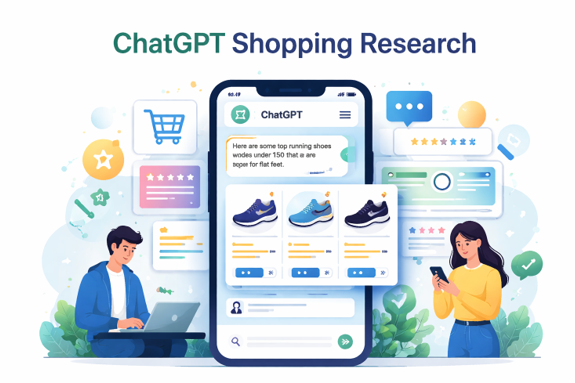
ChatGPT shopping research is an AI-powered experience that allows users to discover, compare, and evaluate products through natural conversation instead of traditional search.
In simple terms, it replaces search, browsing, and product comparison with a single conversational flow.
Rather than typing keywords and jumping between multiple websites, users can now ask questions, refine preferences, and get intelligent recommendations in real time. This is what people mean when they ask, “What is ChatGPT Shopping?” It’s essentially an AI-powered buying assistant.
Why ChatGPT eCommerce Is a Big Deal
Traditional eCommerce discovery is slow and fragmented. A typical journey looks like this:
Search on Google → Open multiple links → Read reviews → Compare products → Decide
With ChatGPT shopping research, the journey is dramatically compressed:
Ask → Refine → Decide
That’s it.
This shift matters because it compresses the entire buying journey into a single interaction.
Did you know?
83% of U.S. adults want personalized shopping experiences, and 74% are more likely to make purchases when they receive them
ChatGPT delivers exactly those personalized, context-aware recommendations at scale.
And the results speak for themselves. Businesses implementing advanced AI personalization are seeing massive returns
Want to see exactly how AI personalization is powering this growth? Check out this deep dive:
Read Also: How AI Personalization is Driving a 25% Sales Surge.
How ChatGPT Shopping Research Works (Step-by-Step)
To understand its impact on eCommerce, you need to see how it works behind the scenes.
1. Conversational Intent Understanding
Users don’t search, they explain.
Example:
When someone says, “Best noise-cancelling headphones for travel under $300,” the AI interprets budget, use case, and implicit preferences all at once. This goes far beyond keyword-based search logic.
2. Smart Follow-Up Questions
Instead of guessing, ChatGPT asks:
-
“Do you prefer over-ear or earbuds?”
-
“Is battery life important?”
This creates a personalized and guided buying experience, similar to a sales associate, but scalable.
3. Deep Shopping Research Across Sources
The system then performs deep product research, analyzing product descriptions, specifications, reviews, and available pricing signals across multiple sources. What traditionally took shoppers extensive manual research is condensed into a structured summary.
Did you know?
53% of shoppers research extensively before buying.
ChatGPT reduces that research time dramatically.
4. Personalized Recommendations
Instead of “top 10 lists,” users get:
-
Best option for their use case
-
Explained trade-offs
-
Alternatives
This is what makes ChatGPT shopping research powerful.
For businesses, the real win comes when you apply this same level of intelligent personalization across your entire customer journey.
5. Real-Time Refinement
Users can ask for cheaper options, exclude a brand, or prioritize durability, and the recommendations update instantly.
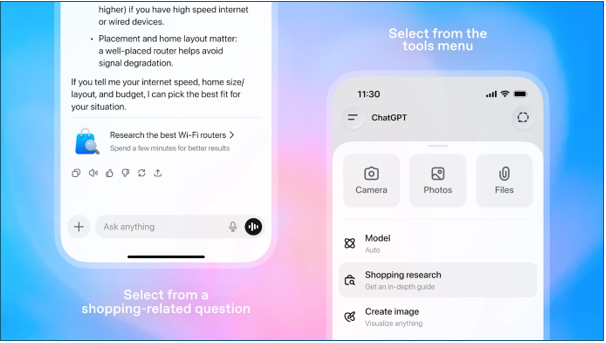
Source: Openai.com
Key Features of the ChatGPT Shopping Feature
Let’s break down the core capabilities of the ChatGPT shopping feature that matters for enterprise eCommerce.
1. End-to-End Product Discovery
Everything happens in one place:
-
Discovery
-
Comparison
-
Decision
No more multi-tab chaos.
2. Hyper-Personalization
Recommendations are based on:
-
User intent
-
Preferences
-
Context
3. Built-In Comparison Engine
Instead of manual comparison:
-
Features are evaluated
-
Pros and cons are highlighted
-
Best-fit recommendations are given
4. Time Efficiency
What used to take 30–60 minutes now takes few minutes.
That’s a massive UX upgrade.
5. Conversational Commerce Experience
This is where conversational commerce meets AI-powered shopping research
Users don’t browse, they talk their way to a decision.
How ChatGPT Shopping Research Impacts eCommerce Businesses
Now let’s talk about strategy.
If you’re running a mid-size or enterprise eCommerce business, this changes how customers find you.
1. Search Is No Longer the Only Entry Point
Customers may never visit Google, see paid ads, or browse category pages. Instead, they rely on ChatGPT eCommerce recommendations. This means discoverability is increasingly driven by AI understanding, not just rankings.
2. Product Pages Become Data Sources
ChatGPT doesn’t “browse” the way humans do. It extracts structured signals. Product descriptions, specifications, use cases, and benefits must be clear and explicit for AI systems to interpret and recommend them accurately.
3. SEO Is Evolving
Traditional SEO focused on keywords, backlinks, and rankings, but that’s no longer enough. Today, AI-driven search prioritizes context, clarity, relevance, and AEO (Answer Engine Optimization). Brands must now create content that not only ranks, but clearly answers the questions AI systems surface during conversational shopping and discovery.
4. Conversion Funnel Is Shrinking
Old funnel:
-
Awareness → Consideration → Decision
New funnel:
-
Conversation → Decision
This means:
-
Less time to influence
-
Higher importance of product clarity
5. Trust Signals Matter More Than Ever
AI systems like ChatGPT heavily weigh signals such as reviews, ratings, detailed feedback, and consistency across sources. Products with weak credibility or unclear representation may never appear in recommendations at all.
ChatGPT eCommerce vs Traditional Shopping Experience
| Feature | Traditional eCommerce | ChatGPT Shopping Research |
|---|---|---|
| Discovery | Search engines | Conversational AI |
| Research | Manual | Automated |
| Comparison | User-driven | AI-driven |
| Personalization | Limited | High |
| Time to decision | 30-60 mins | Minutes |
Benefits of ChatGPT Shopping Research for Users
Understanding user benefits helps you align your strategy.
-
Faster Decisions: Users get answers quickly without research fatigue.
-
Better Product Fit: Recommendations match specific needs.
-
Reduced Overwhelm: No need to browse dozens of options.
-
Smarter Buying Choices: Trade-offs are clearly explained.
Limitations You Should Know
To keep this realistic:
-
Pricing may not always be real-time
-
Not all products are indexed equally
-
Final purchases still happen on retailer sites
This means your website still matters, but discovery is changing.
How eCommerce Brands Should Adapt (Actionable Strategy)
AI systems like ChatGPT heavily weigh signals such as reviews, ratings, detailed feedback, and consistency across sources. Products with weak credibility or unclear representation may never appear in recommendations at all.
Winning in this environment requires rethinking product content, data strategy, and discoverability beyond traditional search.
1. Optimize Product Content for AI
Product pages are no longer just conversion tools for human shoppers; they are primary data sources for AI systems.
This means product content must be
-
Clear and unambiguous
-
Structured logically
-
Focused on real, functional benefits
Overly promotional or buzzword-heavy content makes it harder for AI to accurately understand what your product is, who it’s for, and when it should be recommended. Brands should move toward descriptive, context-rich product narratives that clearly explain use cases, differentiators, and trade-offs.
Think less “marketing copy” and more “decision-enabling clarity.”
2. Strengthen Product Data
AI-driven shopping relies heavily on structured and consistent product data. The stronger and more detailed your product data is, the easier it is for AI systems to extract meaning and confidently recommend your products.
This includes:
-
Detailed specifications
-
Clear use cases and scenarios
-
Well-written FAQs that mirror how customers actually ask questions
The goal is to remove ambiguity. When product data is complete and well organized, AI can match user intent to your products far more effectively during conversational discovery.
3. Prioritize Reviews and Social Proof
Trust is critical for AI-driven recommendations. AI systems evaluate signals like ratings, review quality, and consistency to assess product credibility, and products with weak or limited feedback are less likely to be recommended. Encouraging verified reviews and detailed customer testimonials strengthens both AI visibility and buyer trust.
4. Build Brand Authority
In an AI-first discovery model, brand authority directly impacts visibility. AI systems are more likely to trust and surface brands that consistently demonstrate credibility through quality content, expert insights, and thought leadership, making them more visible in AI-generated recommendations.
5. Think Beyond Google SEO
Yes, traditional SEO still matters, but it is no longer sufficient on its own.
To remain visible in AI-driven shopping experiences, brands must expand their optimization strategy to include:
-
AI visibility, ensuring products are understandable and indexable by AI systems
-
Structured data readiness, so product information is easy to extract and interpret
-
Context-rich content, not just keyword focused pages
-
AEO (Answer Engine Optimization), which focuses on optimizing content to directly answer user questions in conversational environments
In simple words, brands need to optimize not just for how users search but for how AI answers.
The Future of Shopping Research
We’re moving toward a world where:
-
AI acts as the primary shopping assistant
-
Discovery becomes conversation-driven
-
Decisions happen faster
This is not a trend, it’s a structural shift.
Final Thoughts:
If you think ChatGPT shopping research is just another feature, you’re missing the bigger picture.
AI is fast becoming the first touchpoint in the buying journey, replacing traditional search with conversation driven discovery. In ChatGPT eCommerce, product evaluation is automated and contextual, and decisions happen inside intelligent conversations, not long funnels.
For enterprise eCommerce leaders, this shift presents both risk and opportunity. Brands that don’t adapt risk losing visibility before customers ever reach search results. Those that act early can influence buying decisions at the research stage and gain a first-mover advantage in ChatGPT eCommerce.
Now is the time to rethink your digital shelf strategy for an AI-first world.
Leverage Diginyze, an AI-powered eCommerce platform, to future proof your brand for AI-driven shopping discovery.
Book a 30-Minute Free Strategy Call - Request a Demo
FAQs
1. What is ChatGPT shopping?
It refers to the conversational shopping experience enabled by the ChatGPT shopping feature, where AI acts as a virtual shopping assistant. Users describe what they’re looking for, and ChatGPT analyzes product data, reviews, prices, and use cases to recommend the best-fit options, eliminating the need for traditional search and manual comparison.
2. What is shopping research in ChatGPT?
ChatGPT shopping research is an AI-powered approach to shopping that helps users discover, compare, and evaluate products through natural conversation. Instead of browsing multiple websites, users can ask questions, refine preferences, and receive personalized product insights in real time.
In simple terms, shopping research in ChatGPT allows buyers to make faster, more informed decisions within one conversational experience.
3. Do people actually use ChatGPT for online shopping?
Yes, adoption of ChatGPT eCommerce is increasing rapidly. Many users already use ChatGPT for product discovery, comparison, and recommendations, especially when they want faster, more personalized guidance. This behavior is particularly common among tech-savvy consumers and busy professionals who prefer conversational answers over traditional search-based shopping.
4. Does ChatGPT scrape Google for product results?
No, ChatGPT does not scrape Google to generate shopping results. The ChatGPT shopping feature relies on a combination of licensed data, publicly available information, and structured web content. It synthesizes insights contextually to support shopping research, rather than copying or reproducing search engine listings.
5. Do ChatGPT product carousels use Google Shopping data?
No, ChatGPT product carousels do not directly use Google Shopping data.
Recommendations shown in ChatGPT shopping research are generated using aggregated web information, structured product metadata, reviews, and specifications. The focus is on relevance, context, and user intent, rather than paid placement or marketplace dominance.
Related Blogs

The Rise of Voice Commerce and How Diginyze is at the Forefront




What Online Shoppers Really Want: The Ultimate Guide
Recent Blogs
The latest insight into technology and Ecommerce
AI Chatbot for eCommerce: The 24/7 Strategy to Drive 70%+ Conversions and Scale
Did you know? 71% of Gen Z customers buy items via chatbots and 40% of customers use retail digital assistants.
KNOW MORE
AI for Small Retailers: How to Thrive in the E-Retail Revolution
Did you know that U.S. eCommerce sales are expected to hit a record $1.192 trillion in this year, up from $571 billion in 2019?
KNOW MORE
AI-Powered vs. Traditional eCommerce Website Builder: Don’t Get Left Behind!
Choosing the right eCommerce Website Builder is crucial for any eCommerce business.
KNOW MORE
Why Top U.S. Enterprises Are Ditching Legacy eCommerce for AI-First Platforms Like Diginyze
Did you know that U.S. eCommerce sales crossed $1.1 trillion in 2024, yet over 64% of enterprise brands say .....
KNOW MORE
How AI Personalization is Driving a 25% Sales Surge
Did you know? AI-powered search functionalities can increase eCommerce conversion rates by up to 43%, significantly enhancing the efficiency of online shopping platforms. In today's fast-paced eCommerce world, time is of the essence. Customers are no longer willing to sift through endless pages of products just to find what they’re looking for.
KNOW MORE
AI Overviews are Killing Your Traffic: What to do in 2026 and Beyond
Google’s AI Overviews are reshaping search visibility in 2026, causing traffic drops across eCommerce.
KNOW MORE

Advanced AI Security for your Online Store by Diginyze
Cyber Security
Diginyze: Discover the Future of eCommerce Analytics
Futurism AI
AI-Driven eCommerce Marketing with Diginyze
eCommerce
Power your eCommerce Store with Diginyze’s AI-Powered Search & Discovery
Futurism AI
Diginyze: AI-Powered Intelligent eCommerce Platform
eCommerce
Futurism AI: Pioneering
01 Sep 2024
Telecom Transformation: AI Solutions for Call Drops & Billing Woes
Futurism AI
Futurism AI: Tackling Churn and Sustainability for Telcos
Futurism AI
WormGPT Exposed: Decoding the New AI-Driven Cyber Threat
Cyber Security
Futurism DevOps: Unlock DevOps Excellence
Futurism DevOps
Futurism IoT: The Power of Connectivity Awaits!
Futurism IoT:Case Studies




Your Digital Transformation Starts Here!
Join thousands of businesses transforming with Diginyze. Sign up today and start now!